Anaesthesia Courses: Degree, Diploma, Eligibility, and Scope
Nishit Kumar is a senior EdTech industry leader with over a decade of experience in building and scaling education platforms, shaping their product, content, and growth strategy. At…
- 29 Oct 2026NEET PG 2026 online registration window announced
Online application process for NEET PG 2026 runs from 29 Oct 2026 to 5 Nov 2026 for postgraduate medical admissions.
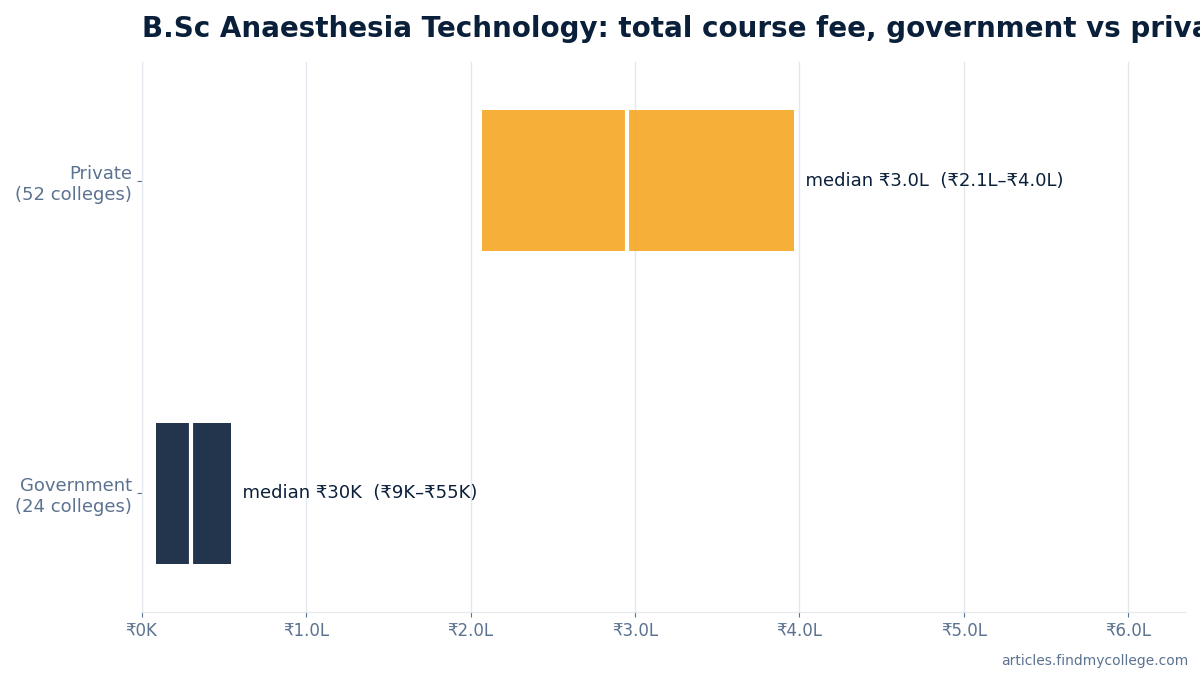
Fresher starting salaries for B.Sc Anaesthesia Technology graduates range between INR 2.5 LPA and INR 4.5 LPA, with overall course fees spanning INR 1,000 to INR 1.05 Crore depending on the college and course level.
Students looking to enter this allied healthcare domain can evaluate undergraduate degrees, diploma options, entrance requirements, college fee structures, curriculum details, and hospital placement salaries across top institutes.
| Parameter | Details |
|---|---|
| Course Levels Available | UG (B.Sc), PG (M.Sc), Diploma, Certificate, and Doctorate (MD) |
| B.Sc Course Duration | 3 years (6 semesters) |
| Diploma Course Duration | 2 years plus 6 months to 1 year compulsory internship |
| NEET Requirement for B.Sc | NEET UG is not mandatory; admissions are mostly based on Class 12 board marks or university entrance tests |
| Fresher Starting Salary | INR 2.5 LPA to INR 4.5 LPA |
| Overall Fee Range | INR 1,000 to INR 1.05 Crore across government and private institutes |
What is B.Sc Anaesthesia Technology
| Program Feature | Details |
|---|---|
| Course Level | Undergraduate (UG) |
| Duration | 3 Years (6 Semesters) |
| Eligibility Criteria | 10+2 Science (PCB) with 45%-50% aggregate score; min 17 years age |
| Core Scope | Assisting anesthesiologists, sterilizing instruments, managing OT equipment, monitoring vital signs |
B.Sc Anaesthesia and Operation Theatre Technology is a 3-year undergraduate degree program divided into 6 semesters. It trains students to assist anesthesiologists during surgical procedures, sterilize instruments, manage operation theatre equipment, and monitor patient vital signs.
B.Sc Anaesthesia Technology Eligibility
Candidates seeking admission to UG Anaesthesia courses must pass Class 12 in the Science stream with Physics, Chemistry, and Biology (PCB). Applicants must be at least 17 years old as of 31st December of the admission year.
NEET UG score is not mandatory for B.Sc Anaesthesia Technology admission in India, as most institutions admit students based on Class 12 board merit. Higher-level programs have distinct criteria: PG Anaesthesia Technology requires a B.Sc in Anaesthesia Technology or MBBS with at least 50% aggregate, while MD in Anesthesiology requires an MBBS degree with 50% marks plus a 1-year compulsory internship. Entrance exams accepted across various course levels include KCET, NEET PG, CUET, NEET UG, INI CET, and CUET-PG.
B.Sc Anaesthesia Technology Admission Process
Admission procedures for undergraduate anaesthesia technology programs vary between merit-based selections and entrance test evaluations. Institutions publish cut-offs based on 10+2 PCB aggregate scores or accept state and national test ranks such as KCET or CUET.
Applicants complete online registration, participate in merit verification or university counselling rounds, present required marksheets and medical fitness documents, and lock their seat allocation through initial fee payment.
B.Sc Anaesthesia Technology Syllabus and Subjects
The curriculum for B.Sc Anaesthesia and OT Technology covers foundational medical science alongside specialised clinical training. Core modules cover Introduction to Anaesthesia & OT, Applied Anaesthesia, Clinical Anaesthesia, Advanced Anaesthesia, and Speciality Anaesthesia.
Students also complete studies in Medicine relevant to Anaesthesia, Surgery relevant to Anaesthesia, Emergency Medicine and Technique, Biostatistics & Research Methodology, and Computer Applications.
| Semester / Subject Category | Key Subjects Covered |
|---|---|
| Core Tech Subjects | Introduction to Anaesthesia & OT Technology, Applied Anaesthesia & OT, Clinical Anaesthesia & OT |
| Advanced Subjects | Advanced Anaesthesia & OT, Speciality Anaesthesia & OT, Emergency Medicine and Technique |
| Medical Foundations | Medicine relevant to Anaesthesia & OT, Surgery relevant to Anaesthesia & OT |
| Allied & Skill Subjects | Computer Application/Programming, Environment Science & Health, Biostatistics & Research Methodology |
How to Apply for B.Sc Anaesthesia Technology Admission in 2026: Step by Step
- Verify Academic Eligibility: Check that you passed Class 12 in the Science stream with Physics, Chemistry, and Biology (PCB), scoring a minimum aggregate of 45% to 50% and reaching 17 years of age by December 31.
- Check Entrance Exam or Merit Criteria: Confirm whether admission is based on Class 12 merit or entrance tests such as KCET or CUET, keeping in mind that NEET UG is not mandatory.
- Submit Application Form: Fill out the online registration form on institution portals (such as admissions.cmcvellore.ac.in), attach the required documents, pay the application fee, and submit.
- Attend Counselling or Merit Verification: Appear for entrance exams if applicable or wait for merit shortlisting, then participate in counselling sessions to select your program.
- Pay Course Fee and Confirm Seat: Pay the prescribed tuition and institutional fees (such as INR 3,776 for first-year Diploma at CMC Vellore Chittoor Campus) to finalize enrollment.
| What to do | Where | Link |
|---|---|---|
| application | CMC Vellore Admissions Portal | admissions.cmcvellore.ac.in |
| Compare colleges, fees and cutoffs | B.Sc Anaesthesia Technology colleges in India | findmycollege.com |
Most colleges grant admission based on Class 12 merit, though select institutions require university or state-level entrance exams. Completing document verification and fee payment secures final admission.
FAQs
Can I become anesthesiologist after B.Sc anesthesia?
No. A B.Sc in Anaesthesia Technology qualifies you as an Anaesthesia Technician or Assistant. To become an anesthesiologist doctor who independently administers anesthesia, you must complete an MBBS degree followed by MD/DNB in Anesthesiology.
What is the salary of anesthesia technician in India?
Fresh B.Sc Anaesthesia Technology graduates earn between INR 2.5 LPA and INR 4.5 LPA. Candidates with 3 to 7 years of experience earn INR 5–7.5 LPA, while senior professionals earn up to INR 12+ LPA.
Is NEET required for B.Sc Anaesthesia Technology?
No, NEET UG is not mandatory for B.Sc Anaesthesia Technology admissions in India. Most colleges grant admission based on Class 12 board exam marks in Physics, Chemistry, and Biology.
What is the scope of BSc anesthesia technology?
Graduates can work as Anaesthesia Technicians, OT Technicians, OT Managers, or Surgical Care Coordinators in hospitals like AIIMS, Fortis, and Apollo, or pursue M.Sc to become educators and clinical researchers.
Is BSc anesthesia equal to doctor?
No, B.Sc Anaesthesia Technology is an allied health science degree. Graduates assist anesthesiologists and manage operation theatre equipment, but they are not medical doctors.
Which course is best for anesthesia technology after 12th?
The 3-year B.Sc in Anaesthesia Technology (or B.Sc Anaesthesia & OT Technology) is the most comprehensive undergraduate degree. Students seeking shorter training can choose a 2-year Diploma in Anaesthesia Technology.