MBBS vs BDS: Which One After a Mid NEET 2026 Score?
Aayush is a writer and content strategist who turns personal stories into brand narratives. With an experience spanning diverse industries, rely on his writing for simplifying complex subjects…
Admission alerts for this course will appear here as official notifications are published.
Choosing between MBBS (Bachelor of Medicine, Bachelor of Surgery) and BDS (Bachelor of Dental Surgery) after a moderate NEET 2026 score is a pivotal decision for many Indian students and their parents. While MBBS leads to a broad medical practice, often requiring extensive postgraduate specialization, BDS offers a focused career in oral healthcare, with significant potential for private practice and specialized dentistry. Your ideal path depends heavily on your aptitude for specific skills, financial considerations, career aspirations, and tolerance for academic rigor.
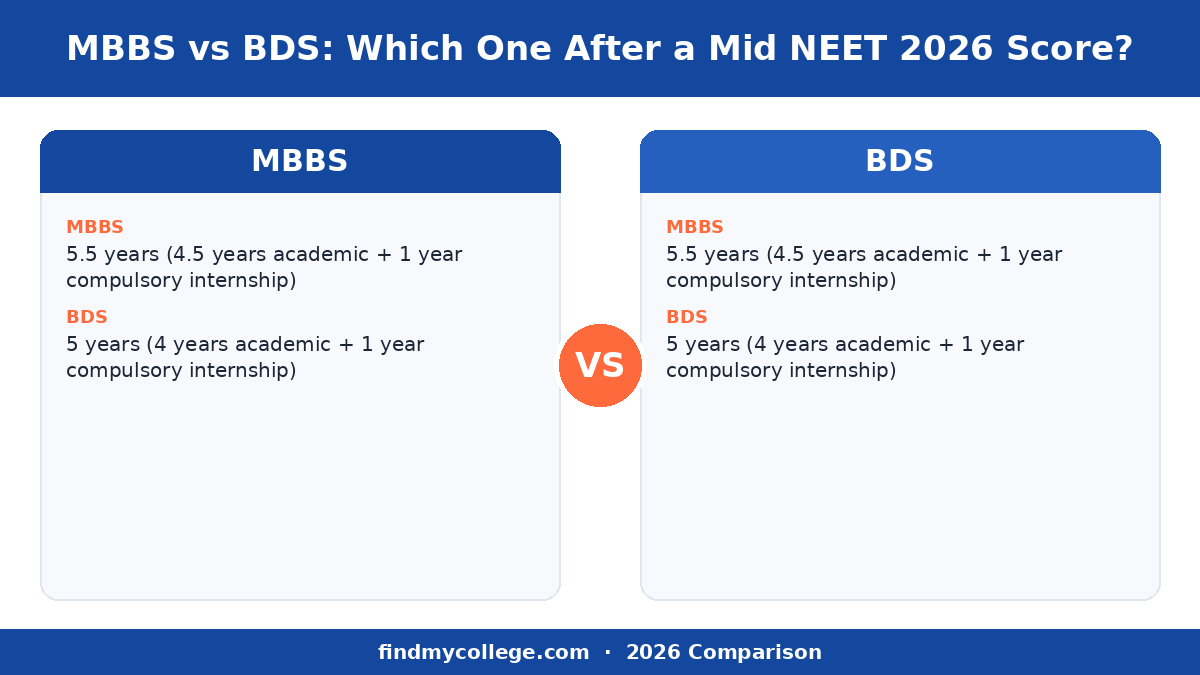
MBBS vs BDS: Quick Comparison (2026)
| MBBS | BDS | |
|---|---|---|
| Duration | 5.5 years (4.5 years academic + 1 year compulsory internship) | 5 years (4 years academic + 1 year compulsory internship) |
| Eligibility | 10+2 with Physics, Chemistry, Biology/Biotechnology & English; minimum 50% aggregate (40% for reserved categories) | 10+2 with Physics, Chemistry, Biology/Biotechnology & English; minimum 50% aggregate (40% for reserved categories) |
| Admission / Entrance | NEET UG (National Eligibility cum Entrance Test – Undergraduate) | NEET UG (National Eligibility cum Entrance Test – Undergraduate) |
| Avg Fees (range) | Government: ₹10,000 – ₹1.5 Lakhs/year; Private: ₹5 Lakhs – ₹25 Lakhs/year | Government: ₹10,000 – ₹1 Lakh/year; Private: ₹2 Lakhs – ₹10 Lakhs/year |
| Top Careers | General Physician, Specialist (after PG), Surgeon, Medical Researcher, Public Health Officer | General Dentist, Orthodontist, Oral Surgeon, Periodontist, Endodontist (after MDS), Dental Researcher |
| Avg Starting Salary | ₹3 Lakhs – ₹8 Lakhs/year (after internship, before PG) | ₹2 Lakhs – ₹6 Lakhs/year (after internship, before MDS) |
| Best For | Broad medical interest, high academic rigor, long-term specialization, patient care across diverse conditions. | Specific interest in oral health, fine motor skills, entrepreneurial drive for private practice, relatively shorter specialization path. |
Curriculum & Focus
The MBBS curriculum is vast, covering the entire human body, its systems, diseases, and treatments. It emphasizes theoretical knowledge, diagnostic reasoning, and a holistic approach to patient care. Students delve into subjects like Anatomy, Physiology, Pathology, Pharmacology, and various clinical specialties. In contrast, BDS focuses specifically on oral and maxillofacial health, encompassing teeth, gums, jaws, and associated structures. While it includes foundational medical sciences, the emphasis quickly shifts to dental anatomy, oral pathology, restorative dentistry, orthodontics, and surgical procedures within the oral cavity. MBBS demands a broader understanding of systemic health, whereas BDS requires precision and manual dexterity for intricate dental procedures.
Difficulty & Workload
Both degrees are academically demanding, but their challenges differ. MBBS is widely considered more intellectually rigorous and emotionally taxing due to the sheer volume of information, the complexity of human diseases, and the high-stakes nature of medical decisions. The workload is intense, with long study hours, extensive clinical rotations, and significant emotional toll from dealing with severe illness and mortality. BDS, while challenging, often involves a greater emphasis on practical skills and fine motor coordination. While theoretical knowledge is crucial, the ability to perform precise procedures like fillings, extractions, and root canals is paramount. Many students find the practical, hands-on nature of dentistry engaging, though it still requires dedication and consistent effort.
Fees & ROI
The financial investment for both courses varies significantly between government and private institutions. Generally, MBBS in private colleges tends to be substantially more expensive than BDS, with annual fees often reaching upwards of ₹20-25 lakhs. This higher initial investment for MBBS often translates into a longer break-even period, especially if pursuing extensive postgraduate specialization. BDS, particularly in government colleges, offers a more affordable entry point. While starting salaries for BDS might be lower than MBBS, the potential for establishing a successful private practice with a relatively lower initial setup cost can lead to a quicker return on investment for entrepreneurial dentists. However, both fields require significant investment in higher education for optimal career progression.
Placements & Salary
Upon graduation, MBBS graduates have a broader range of immediate employment opportunities, including roles as junior residents, medical officers in government hospitals, or general practitioners. However, the most lucrative and respected positions typically require postgraduate specialization (MD/MS), which adds another 3 years of study. Starting salaries for MBBS doctors can range from ₹3-8 lakhs per annum, increasing significantly with specialization and experience. BDS graduates typically start as junior dentists in clinics, hospitals, or establish their own small practices. Initial salaries might be slightly lower, ranging from ₹2-6 lakhs per annum. However, the potential for self-employment and the establishment of a private dental clinic offers significant earning potential over time, often surpassing that of a general MBBS practitioner without specialization. MDS (Master of Dental Surgery) is crucial for higher earnings and specialized practice in dentistry.
Higher Studies & Abroad Scope
Both MBBS and BDS offer extensive avenues for higher studies. For MBBS graduates, the primary path is postgraduate specialization (MD/MS/DNB) in various medical and surgical fields, which is almost a prerequisite for a fulfilling career. The scope for working abroad is significant, with many Indian doctors pursuing licensing exams (e.g., USMLE for USA, PLAB for UK, AMC for Australia) to practice internationally. BDS graduates pursue MDS in specialties like Orthodontics, Oral Surgery, Periodontics, etc. While the direct path to practicing abroad as a dentist can be more challenging due to varying licensing requirements and saturation in some countries, opportunities exist, particularly for highly specialized dentists. Both degrees require rigorous preparation for international licensing exams.
Government-Job Scope
MBBS graduates have a substantial scope for government jobs, including roles as Medical Officers in primary health centers (PHCs), community health centers (CHCs), district hospitals, and various state and central government health services. These positions often offer job security, decent pay, and benefits, though they may involve postings in rural or remote areas. BDS graduates also have government job opportunities, primarily as Dental Surgeons in government hospitals, PHCs, CHCs, and in the armed forces. However, the number of government dental positions is generally fewer compared to medical positions, making competition quite stiff. Many BDS graduates eventually opt for private practice due to the limited availability of government roles.
What students actually say (community insights)
- Many students acknowledge that MBBS is an incredibly demanding path, often taking a significant toll on mental and physical health due to the intense workload and emotional challenges.
- There’s a strong sentiment that BDS offers a more direct route to self-employment and private practice, appealing to those with an entrepreneurial mindset, whereas MBBS is often perceived as more job-based, especially initially.
- A common discussion point revolves around the perceived saturation in the dental field, with some students expressing concerns about low starting salaries for plain BDS graduates without an MDS. However, others counter that with specialization and a good private setup, dentistry can be very rewarding.
- Students often highlight the fundamental difference in skill sets: MBBS is seen as more theoretical and intellectual, requiring extensive diagnostic reasoning, while BDS is described as more hands-on, requiring precision motor and sensory skills.
- While some students might consider BDS as a fallback option after not securing an MBBS seat, a growing number are consciously choosing BDS, valuing its specific focus and potential for a balanced lifestyle compared to the perceived intensity of MBBS.
- There’s a general consensus that MBBS offers broader career flexibility and more diverse specialization options compared to the more focused scope of dentistry.
Which one should you choose?
Your decision should align with your interests, aptitude, and long-term career goals:
- Choose MBBS if: You have a deep passion for understanding the human body holistically, are prepared for extensive academic rigor and a long specialization path, are comfortable with high-stakes decision-making, and envision a career in diverse medical fields or research. You are also prepared for a potentially higher financial investment and a longer period before achieving peak earning potential.
- Choose BDS if: You have a specific interest in oral health, possess excellent fine motor skills and attention to detail, are inclined towards a career with significant potential for private practice, and prefer a relatively shorter specialization path compared to many MBBS specializations. You value the hands-on nature of the profession and are comfortable with a more focused area of healthcare.
Frequently Asked Questions
Is BDS really saturated in India?
While the number of BDS graduates has increased, leading to competition, the perception of saturation is often debated. Success in dentistry heavily relies on specialization (MDS), clinical skills, and entrepreneurial ability to establish a successful private practice. Good dentists with specialized skills are always in demand.
Can I switch from BDS to MBBS later?
No, there is no direct lateral entry or conversion path from BDS to MBBS. Both are distinct undergraduate degrees. If you wish to pursue MBBS after BDS, you would need to appear for NEET UG again and complete the entire 5.5-year MBBS course.
Which degree offers better work-life balance?
Generally, BDS is perceived to offer a better work-life balance, especially after establishing a private practice where you can set your own hours. MBBS, particularly during residency and early career, often involves long, unpredictable hours and high-stress situations. However, this can vary greatly with specialization and individual career choices in both fields.
Is it worth taking a private BDS seat over dropping for MBBS?
This depends on your financial situation, passion, and risk tolerance. If you have a genuine interest in dentistry and can afford a good private BDS college, it might be a viable option to start your career sooner. If your heart is set on MBBS and you believe you can improve your NEET score, dropping for another attempt might be worthwhile, provided you have a strong study plan and support system.
What is the scope of MDS after BDS?
MDS (Master of Dental Surgery) significantly enhances the career prospects of a BDS graduate. It allows specialization in fields like Orthodontics, Oral & Maxillofacial Surgery, Periodontics, Endodontics, etc., leading to higher earning potential, better job opportunities in hospitals, and the ability to offer specialized services in private practice.
Are there any common subjects between MBBS and BDS?
Yes, both MBBS and BDS curricula include foundational medical sciences in the initial years, such as Anatomy, Physiology, Biochemistry, Pathology, Microbiology, and Pharmacology. However, the depth and focus on these subjects diverge significantly as the courses progress, with BDS concentrating on their relevance to oral health.
Which degree is more respected in society?
Historically, MBBS has held a slightly higher societal prestige due to the broader scope of medical practice and life-saving interventions. However, dentistry is a highly respected and essential healthcare profession. The respect earned ultimately depends on an individual’s competence, ethical practice, and contribution to patient well-being in either field.
Can I practice abroad with an Indian BDS degree?
Yes, it is possible, but it requires clearing specific licensing examinations and fulfilling registration requirements of the respective country. These processes can be rigorous and vary significantly by nation (e.g., NBDE for USA, ORE for UK, ADC for Australia). Some countries may also require additional training or residency programs.{“@context”: “https://schema.org”, “@type”: “FAQPage”, “mainEntity”: [{“@type”: “Question”, “name”: “Is BDS really saturated in India?”, “acceptedAnswer”: {“@type”: “Answer”, “text”: “While the number of BDS graduates has increased, leading to competition, the perception of saturation is often debated. Success in dentistry heavily relies on specialization (MDS), clinical skills, and entrepreneurial ability to establish a successful private practice. Good dentists with specialized skills are always in demand.”}}, {“@type”: “Question”, “name”: “Can I switch from BDS to MBBS later?”, “acceptedAnswer”: {“@type”: “Answer”, “text”: “No, there is no direct lateral entry or conversion path from BDS to MBBS. Both are distinct undergraduate degrees. If you wish to pursue MBBS after BDS, you would need to appear for NEET UG again and complete the entire 5.5-year MBBS course.”}}, {“@type”: “Question”, “name”: “Which degree offers better work-life balance?”, “acceptedAnswer”: {“@type”: “Answer”, “text”: “Generally, BDS is perceived to offer a better work-life balance, especially after establishing a private practice where you can set your own hours. MBBS, particularly during residency and early career, often involves long, unpredictable hours and high-stress situations. However, this can vary greatly with specialization and individual career choices in both fields.”}}, {“@type”: “Question”, “name”: “Is it worth taking a private BDS seat over dropping for MBBS?”, “acceptedAnswer”: {“@type”: “Answer”, “text”: “This depends on your financial situation, passion, and risk tolerance. If you have a genuine interest in dentistry and can afford a good private BDS college, it might be a viable option to start your career sooner. If your heart is set on MBBS and you believe you can improve your NEET score, dropping for another attempt might be worthwhile, provided you have a strong study plan and support system.”}}, {“@type”: “Question”, “name”: “What is the scope of MDS after BDS?”, “acceptedAnswer”: {“@type”: “Answer”, “text”: “MDS (Master of Dental Surgery) significantly enhances the career prospects of a BDS graduate. It allows specialization in fields like Orthodontics, Oral & Maxillofacial Surgery, Periodontics, Endodontics, etc., leading to higher earning potential, better job opportunities in hospitals, and the ability to offer specialized services in private practice.”}}, {“@type”: “Question”, “name”: “Are there any common subjects between MBBS and BDS?”, “acceptedAnswer”: {“@type”: “Answer”, “text”: “Yes, both MBBS and BDS curricula include foundational medical sciences in the initial years, such as Anatomy, Physiology, Biochemistry, Pathology, Microbiology, and Pharmacology. However, the depth and focus on these subjects diverge significantly as the courses progress, with BDS concentrating on their relevance to oral health.”}}, {“@type”: “Question”, “name”: “Which degree is more respected in society?”, “acceptedAnswer”: {“@type”: “Answer”, “text”: “Historically, MBBS has held a slightly higher societal prestige due to the broader scope of medical practice and life-saving interventions. However, dentistry is a highly respected and essential healthcare profession. The respect earned ultimately depends on an individual’s competence, ethical practice, and contribution to patient well-being in either field.”}}]}