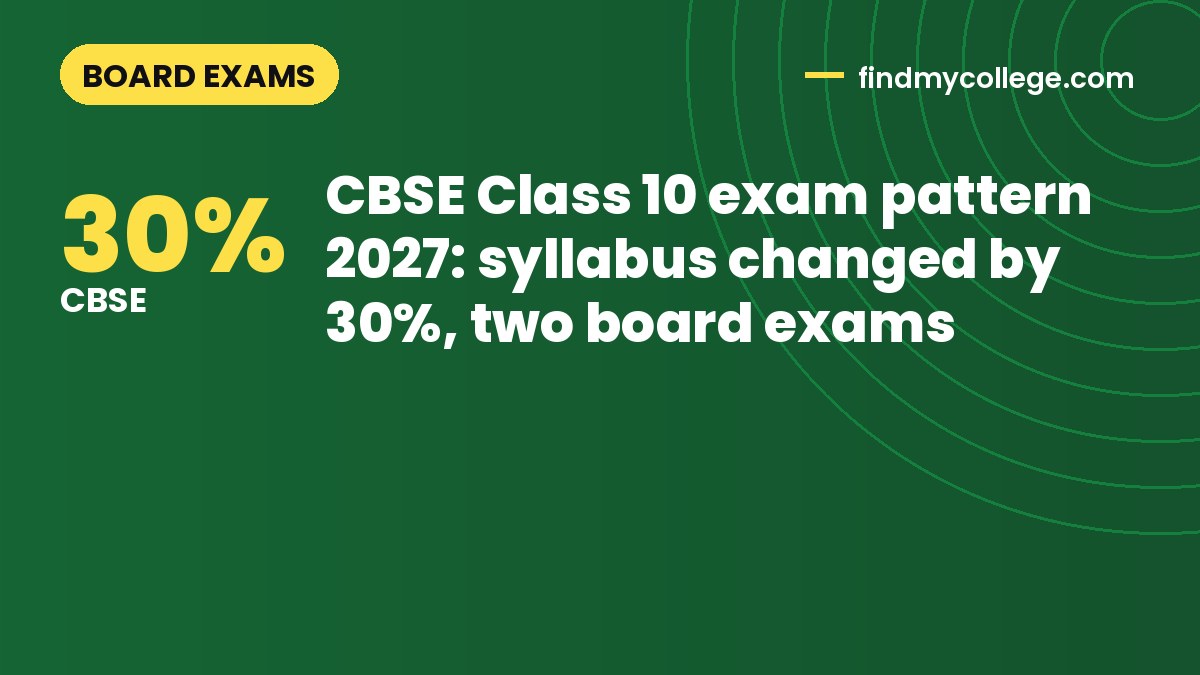
CBSE Class 10 exam pattern 2027: syllabus changed by 30%, two board exams
In short
- The CBSE Class 10 syllabus for the 2026-27 academic year has been changed by 30% to support overall student development.
- The 2027 CBSE Class 10 board exams will be conducted in two phases, with Phase 1 in February and Phase 2 likely in May.
- Each subject will carry a maximum of 100 marks, comprising 80 for theory and 20 for internal assessment, with a 33% passing mark.
- Competency-based questions will account for 50% of the paper, with constructed response questions at 20% and long answer questions at 30%.
- Students must appear in five subjects, including three core and two elective subjects, with NCERT textbooks as the primary resource.
The Central Board of Secondary Education (CBSE) has released the Class 10 Syllabus and detailed the Exam Pattern and Marking Scheme for the Academic Year 2026-27, applicable for the 2027 Board Exams. These changes aim to improve the examination process for students and support their overall development.
The CBSE Class 10 syllabus for 2026-27 has been revised by 30%, with the board giving increased weightage to application, case-study, and situation-based questions over direct theory-based ones. Selected topics have been reduced or combined to minimise content overload, encouraging students to focus on core concepts and analytical thinking.
Revised Examination Structure and Schedule
The CBSE Class 10 board exams for the 2026-27 academic year will be conducted in two phases. Phase 1 is scheduled for February 2027, with Phase 2 likely to take place from May 2027. All examinations will be conducted in an offline, pen-and-paper mode. Students will be allotted 15 minutes to read the question papers thoroughly before commencing the exam.
Each subject will carry a maximum of 100 marks, with 80 marks allocated for the theory paper and 20 marks for internal assessment. The total duration for the theory paper is three hours for most subjects, except Computer Application, which has a two-hour theory paper. Passing marks are set at 33% in each subject, combining both theory and internal assessment scores. There will be no negative marking for incorrect answers. The CBSE follows a 9-point grading system for results.
| Particulars | Details |
|---|---|
| Exam Mode | Pen and Paper (Offline) |
| Exam Duration | 3 hours for each subject |
| Total Marks per Subject | 100 marks (80 theory + 20 internal assessment) |
| Question Types | MCQs, Case-Based, Assertion-Reasoning, Short Answer, Long Answer |
| Passing Marks | 33% in each subject (theory + internal combined) |
| Negative Marking | No negative marking |
Question Paper Design and Internal Assessment
The exam pattern for the 2027 board exams includes various question types: Multiple Choice Questions (MCQs), Case-Based questions, Assertion-Reasoning, Short Answer, and Long Answer questions. Competency-based questions will constitute 50% of the paper, constructed response questions 20%, and long answer questions 30%. The question paper is generally divided into multiple sections, including Objective (MCQs), Very Short Answer (VSA), Short Answer (SA), Long Answer (LA), and Case-Based/Source-based questions.
Internal assessment, contributing 20 marks to each subject, is distributed across four components: Periodic Tests (5 marks), Multiple Assessments (5 marks), Portfolio (5 marks), and Subject Enrichment Activities (5 marks). Calculators are not permitted in the CBSE Class 10 board exams. Students are required to appear in five subjects, comprising three core and two elective subjects. NCERT textbooks are identified as the primary and most important resource, with 80-90% of questions expected to be derived directly from them.
| Component | Marks |
|---|---|
| Periodic Tests (Best 2 out of 3) | 5 marks |
| Multiple Assessments (Quizzes, Discussions, Presentations) | 5 marks |
| Portfolio (Classwork, Assignments, Project Work) | 5 marks |
| Subject Enrichment Activities (Practical/Lab Work, Maps, Models) | 5 marks |
| Total Internal Assessment | 20 marks |
Subject-Specific Marking Schemes
The syllabus for English Class 10 includes Reading Skills, Writing Skills with Grammar, and Language & Literature. The Science syllabus is divided into five sections, while the Social Studies syllabus covers Political Science, History, Geography, and Economics. Mathematics offers two options: Mathematics Standard, designed for students pursuing Maths in Class 11, and Mathematics Basic, for those not opting for Maths in higher classes.
The theory paper for Mathematics is valued at 80 marks, with 20 marks for internal assessment. Similarly, Science and Social Science also follow an 80-mark theory and 20-mark internal assessment structure. Computer Application has a 50-mark theory paper and 50 marks for practical assessment. The detailed syllabus for CBSE Class 10 2026-27 is available online at cbseacademic.nic.in, and the official website for updates is cbse.gov.in.
| Subject | Theory Marks | Internal Assessment | Total Marks | Time Limit |
|---|---|---|---|---|
| Mathematics | 80 | 20 | 100 | 3 hours |
| Science | 80 | 20 | 100 | 3 hours |
| English | 80 | 20 | 100 | 3 hours |
| Hindi (A & B) | 80 | 20 | 100 | 3 hours |
| Social Science | 80 | 20 | 100 | 3 hours |
| Computer Application | 50 (Theory) | 50 (Practical) | 100 | 2 hours (Theory) |
| Accountancy | 70 | 30 | 100 | 3 hours |
Further reading

📰 More Education News
- After 10th Diploma Meghalaya 2026: Apply for college admission nowSep 30, 2026 • Nishit Kumar
- GPAT: Apply for M.Pharma by Sep 29, 2026 at Rajaram & Tarabai Bandekar CollegeSep 30, 2026 • Nishit Kumar
- JEE Main 2027: high-scoring chapters to cover 40% of syllabus for top marksSep 30, 2026 • Nishit Kumar
- CLAT 2027 scorecard release expected in late December or early JanuarySep 30, 2026 • Nishit Kumar