CBSE Class 12 Mathematics sample paper 2026-27 released: new exam pattern details
In short
- The CBSE Class 12 Mathematics Sample Question Paper and Marking Scheme for the 2026-27 exam were released on September 21, 2026.
- The theory paper is for 80 marks with a duration of 3 hours, comprising 38 questions across five sections.
- The updated exam pattern includes 20% MCQs, 30% competency-based questions, and 50% short and long answer questions.
- Internal Assessment for Mathematics carries 20 marks, evaluated by the school, and includes periodic tests, lab activities, and projects.
- Students can download the official sample paper and marking scheme from cbseacademic.nic.in to understand the latest exam typology.
The Central Board of Secondary Education (CBSE) released the Class 12 Mathematics Sample Question Paper (SQP) and Marking Scheme (MS) for the 2026-27 examination on September 21, 2026. These resources are available on the official website, cbseacademic.nic.in, to assist students in preparing for the upcoming CBSE Class 12 Maths Board Exam.
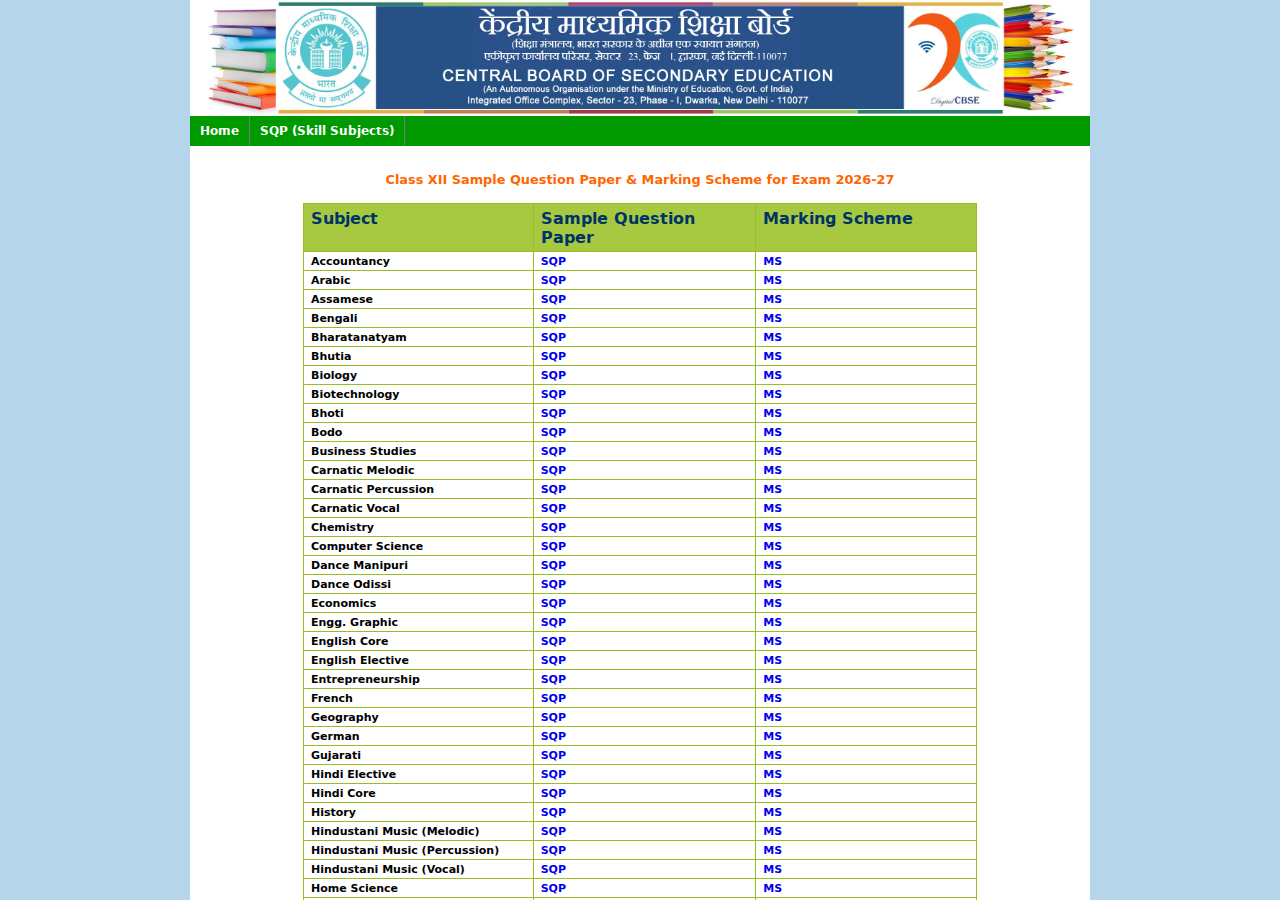
The release aims to provide students with a clear understanding of the latest exam pattern, marking scheme, and question typology, which have been updated to emphasize skill-oriented and reasoning-based questions. The theory paper is designed for 80 marks and has a duration of three hours, with an additional 20 marks allocated for Internal Assessment.
Revised Exam Pattern and Question Typology
The CBSE Class 12 Mathematics sample paper for 2026-27 reflects a shift towards more skill-oriented and reasoning-based questions, as outlined by the board. The updated exam pattern for 2026-27 allocates specific weightage to different question types, including multiple-choice, competency-based, and descriptive questions. Recent updates also feature an increased number of internal choices in long questions, the inclusion of Assertion-Reasoning type MCQs in conceptual topics, and real-life case-based problems.
The board has also emphasized increased focus on stepwise marking with proper working and reasoning in answers. The NCERT Mathematics textbooks (Part I and Part II) for Class 12 remain the primary reference for board questions.
| Component | Weightage | Description |
|---|---|---|
| MCQs | 20% | Objective-type questions including single correct answers |
| Competency-Based Questions | 30% | Case-based, source-based, assertion-reason, and application-based questions |
| Short & Long Answer Questions | 50% | Descriptive type questions testing conceptual clarity and explanation |
Mathematics Paper Structure and Internal Assessment
The theory paper for Class 12 Mathematics contains 38 questions, divided into five sections: A, B, C, D, and E. Section A consists of 20 Multiple Choice Questions (MCQs) of 1 mark each, including Assertion-Reason based questions. Section B comprises 5 Very Short Answer (VSA)-type questions, each carrying 2 marks. Section C includes 6 Short Answer (SA)-type questions, carrying 3 marks each. Section D contains 3 Long Answer (LA)-type questions, each carrying 5 marks. Finally, Section E includes 3 Case study-based questions, each carrying 4 marks. While there is no overall choice, approximately 33% internal choice is provided across sections. Using calculators is not permitted during the exam.
Mathematics does not have a practical exam but carries 20 marks of Internal Assessment, which is assessed by the school. This internal assessment includes periodic tests, a mathematics lab activity or portfolio, and a project. This structure aligns with the broader subject-wise maximum marks distribution across different streams, where Science subjects have 70 marks for theory and 30 for practicals, while Commerce, Humanities, and Languages typically have 80 marks for theory and 20 for project or internal assessment.
| Sections | Question Types | No. of Questions |
|---|---|---|
| Section A | Multiple Choice Questions | 20Q (1m) |
| Section B | Very Short Answer (VSA) | 5Q (2m) |
| Section C | Short Answer (SA) | 6Q (3m) |
| Section D | Case Study Based | 4Q (5m) |
| Section E | Long Answer (LA) | 3Q (4m) |
Preparation Guidance for Students
The release of the sample papers is a key resource for strategized practice, helping students understand question formats, section-wise weightage, and the expected difficulty level in the final board examination. Students are advised to download the sample papers and marking schemes from the official CBSE academic website. Thorough completion of the CBSE Class 12 Maths Syllabus 2026-27 is recommended.
Regular practice with these solutions is intended to improve answer presentation, time management, and accuracy, plus help identify weak areas. Students are encouraged to practice solving full papers under a strict three-hour timer without a calculator and to analyze their mistakes to revise weak topics. Prioritizing Calculus due to its high weightage, followed by Vectors and 3D Geometry, and Linear Programming for quick returns, is also suggested.
Subject-Wise Marks Distribution
The CBSE has outlined the maximum marks distribution for various subject types in Class 12. For Science subjects such as Physics, Chemistry, and Biology, the theory component accounts for 70 marks, with 30 marks allocated for practical examinations, totaling 100 marks. Commerce subjects, including Accountancy, Business Studies, and Economics, have an 80-mark theory paper and a 20-mark project component, also totaling 100 marks. Similarly, Humanities and Languages follow an 80-mark theory and 20-mark internal assessment structure, culminating in a total of 100 marks.
| Stream / Subject Type | Theory Marks | Practical / Internal | Total Marks |
|---|---|---|---|
| Science (Physics, Chemistry, Biology) | 70 | 30 Practical | 100 |
| Commerce (Accountancy, Business Studies, Economics) | 80 | 20 Project | 100 |
| Humanities & Languages | 80 | 20 Internal Assessment | 100 |
Further reading

📰 More Education News
- CLAT 2026: Apply by Dec 7 for law courses after 12thSep 24, 2026 • Nishit Kumar
- R. C. Patel B.Pharm 2025-26: Pay ₹1,51,000 interim fee at admissionSep 24, 2026 • Nishit Kumar
- PTU MBA 2026: Apply with 50% UG + Entrance Test for HR, Marketing, FinanceSep 24, 2026 • Nishit Kumar
- ICAI CA January 2027 exam dates out: Foundation, Intermediate schedules releasedSep 24, 2026 • Nishit Kumar