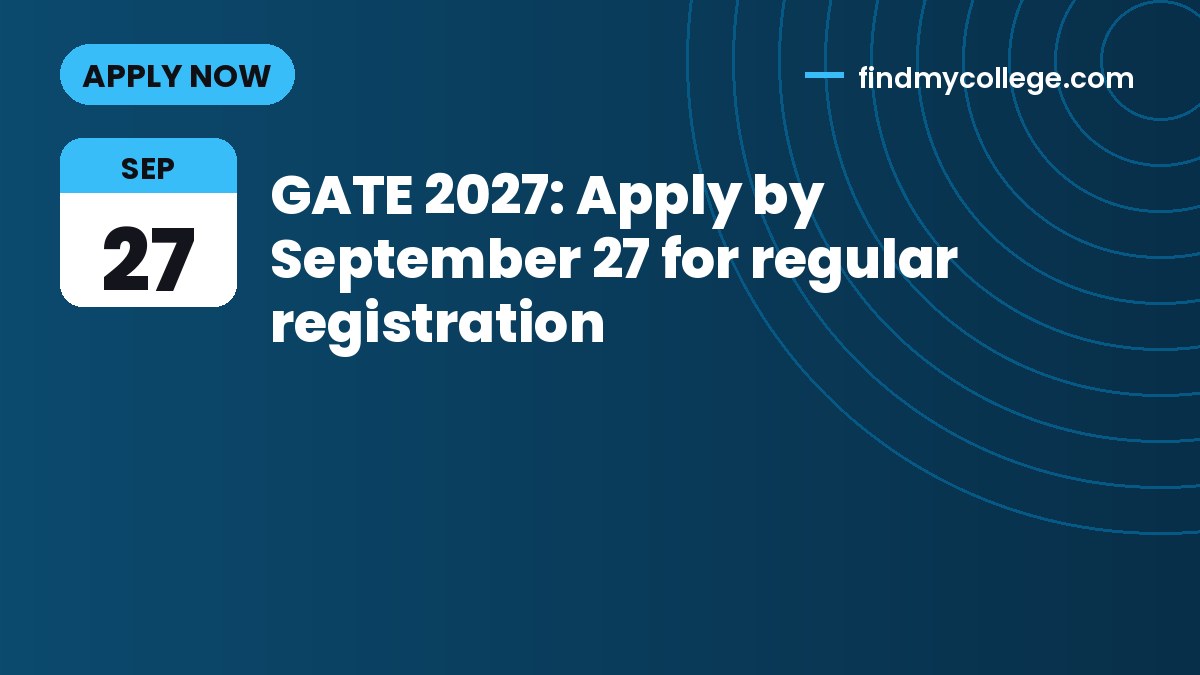
GATE 2027: Apply by September 27 for regular registration
In short
- The regular registration window for GATE 2027, without a late fee, closes on September 27, 2026.
- Candidates can apply online through the GOAPS portal at gate2027.iitm.ac.in.
- A new Robotics & Automation (RA) paper has been introduced for GATE 2027, which will cover 30 test papers in total.
- DigiLocker-based registration is mandatory for Indian nationals, requiring address and date of birth details to be fetched.
- The application fee is INR 1000 for Female/SC/ST/PwD candidates and INR 2000 for other candidates, per test paper, for regular registration.
IIT Madras, the organizing institute for GATE 2027, is currently accepting applications for the Graduate Aptitude Test in Engineering. The regular registration period for the national-level examination is scheduled to close on September 27, 2026. Aspiring candidates for postgraduate and doctoral programs, as well as Public Sector Undertaking (PSU) recruitment, must complete their applications online via the GOAPS portal at gate2027.iitm.ac.in.
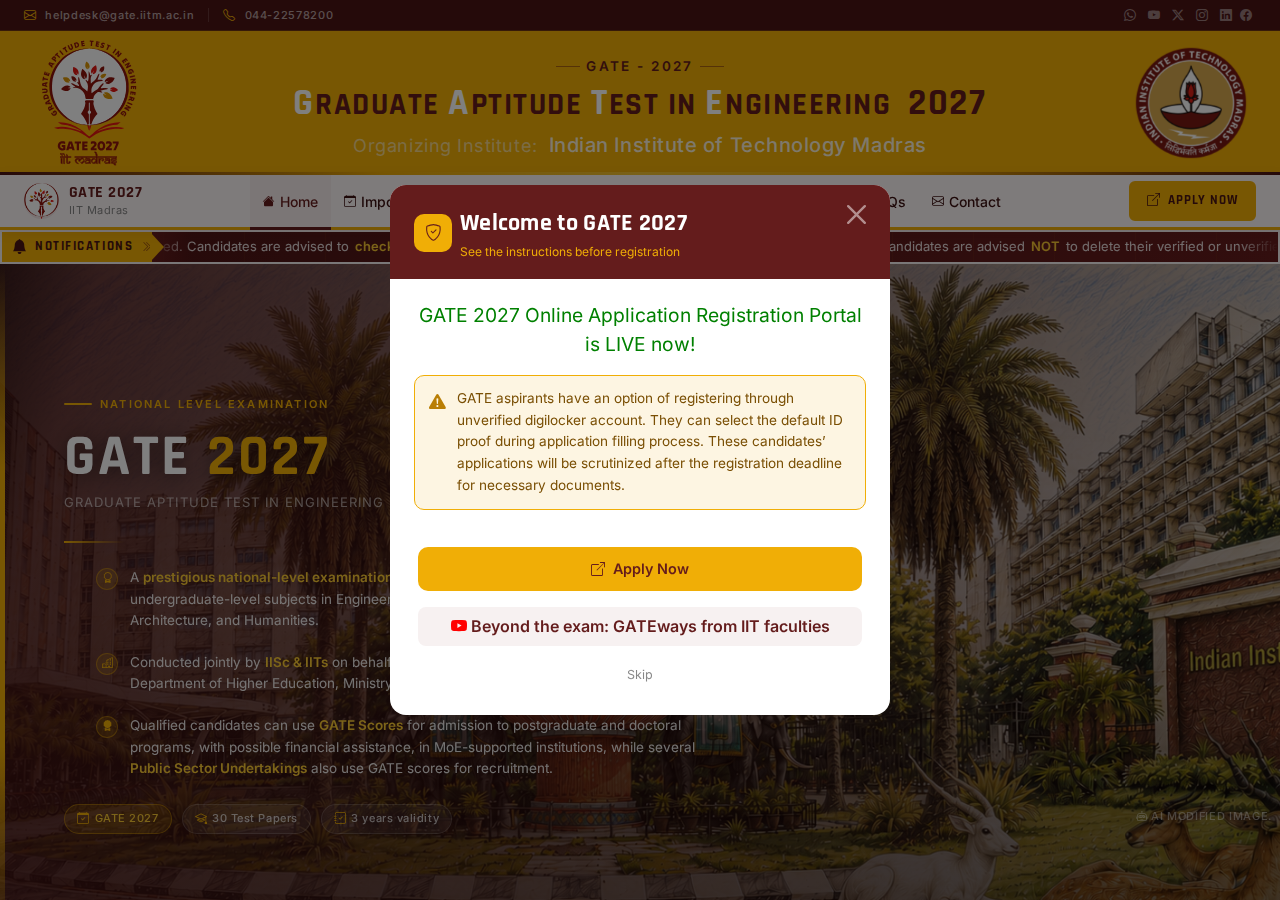
The GATE examination evaluates candidates’ understanding of undergraduate-level subjects across various disciplines, including Engineering, Technology, Science, Commerce, Arts, Architecture, and Humanities. This year’s examination introduces a new Robotics & Automation (RA) paper, revised syllabi, and updated paper codes for XE/XH/XL, alongside an upgraded registration process featuring live facial verification and mandatory DigiLocker integration for Indian nationals.
GATE 2027 Registration and Deadlines
The GOAPS Registration portal for GATE 2027 opened on September 2, 2026. Candidates are advised to complete their applications by September 27, 2026, to avoid late fees. An extended registration deadline, which includes a late fee, is available until October 5, 2026. Following the registration period, an application rectification window will be open from October 14 to October 21, 2026, allowing candidates to make necessary corrections to their submitted forms.
The GATE 2027 Information Brochure, detailing all examination guidelines and procedures, was officially released on July 20, 2026. The examination is conducted jointly by IISc and IITs on behalf of the National Coordination Board (NCB), Department of Higher Education, Ministry of Education (MoE), Government of India. GATE scores remain valid for a period of three years from the date of announcement.
| Event | Date |
|---|---|
| Information Brochure released | 20 July 2026 |
| Registration opens (GOAPS) | 2 September 2026 |
| Regular Registration Closes (without late fee) | 27 September 2026 |
| Extended Registration Closes (with late fee) | 5 October 2026 |
| Application Rectification Window Opens | 14 October 2026 |
| Application Rectification Window Closes | 21 October 2026 |
| City Allotment Notification | 4 January 2027 |
| Admit Card Download | 4 January 2027 |
| GATE 2027 Exam Dates | 6, 7, 13, 14, 20 & 21 February 2027 |
| Result Announcement | 19 March 2027 |
Eligibility Criteria and Application Fees
Candidates in their 3rd year or higher of a 4-year undergraduate degree, or those who have already completed a qualifying degree, are eligible to appear for GATE 2027. There is no upper age limit for candidates wishing to take the examination. The application fee varies based on candidate category and the registration period, with a non-refundable fee structure in place.
For Female, SC, ST, and PwD candidates, the regular application fee is INR 1000 per test paper. This increases to INR 1500 per test paper during the extended registration period. For all other candidates, including General, OBC-NCL, EWS, and foreign nationals, the regular fee is INR 2000 per test paper, which rises to INR 2500 per test paper for extended registration.
| Category | Regular Fee (per paper) | Extended Fee (per paper) |
|---|---|---|
| Female/SC/ST/PwD candidates | INR 1000 | INR 1500 |
| Other candidates (Gen/OBC-NCL/EWS/Foreign nationals) | INR 2000 | INR 2500 |
Application Process and Document Requirements
The application process mandates DigiLocker-based registration for Indian nationals, where address and Date of Birth (DOB) details will be fetched from DigiLocker or Aadhaar. While academic documents such as 10th, 12th, UG, and PG marksheets are not required to be uploaded to DigiLocker for GATE 2027 registration, SC/ST and PwD certificates must be uploaded during the registration process. OBC-NCL and EWS certificates are generally required at the counselling stage.
Applicants must upload a recent passport-size photograph and a scanned signature adhering to specific guidelines. The photograph must be in JPEG/JPG format, with a maximum file size of 600 KB, showing the face covering 60-70% of the image against a plain white background. The scanned signature, also in JPEG/JPG format, should be in black or dark blue ink on white paper, with a maximum file size of 300 KB. Candidates can select up to two test papers from approved combinations and must provide six examination city preferences.
| Item | GATE 2027 Requirement |
|---|---|
| Photograph format | JPEG/JPG, recent color photo |
| Photograph resolution | Min 200×260 px, Max 530×690 px |
| Photograph file size | Max 600 KB |
| Photograph background | Plain white, no other objects or persons |
| Face coverage | Face must cover 60–70% of the photo after cropping, frontal view, no head covering (except religious reasons) |
| Item | GATE 2027 Requirement |
|---|---|
| Signature format | JPEG/JPG, black or dark blue ink on white paper |
| Signature resolution | Min 250×80 px, Max 580×180 px |
| Signature file size | Max 300 KB |
| Signature aspect ratio | Height : Width between 1:2.75 and 1:3.75 |
| Signature area coverage | After cropping to the required size, the signature must cover 70–80% of the image |
Further reading

📰 More Education News
- Haryana NEET UG 2026 Round 3 counselling schedule released: last date to join October 1Sep 25, 2026 • Nishit Kumar
- Apply for M.Pharm Industrial Pharmacy in Andhra Pradesh for 2026 admissionsSep 25, 2026 • Nishit Kumar
- OPJS M.Pharm 2026: Apply with B.Pharm 55% for 2-year program, INR 1 lakh feeSep 25, 2026 • Nishit Kumar
- JCECEB ANM 2026 round 2 seat allotment result out; document verification by September 30Sep 25, 2026 • Nishit Kumar