JEE Main 2027 preparation: high-scoring topics can cover 70% of paper
In short
- The JEE Main syllabus comprises 64 chapters, with Chemistry identified as the most scoring subject for JEE Main 2027.
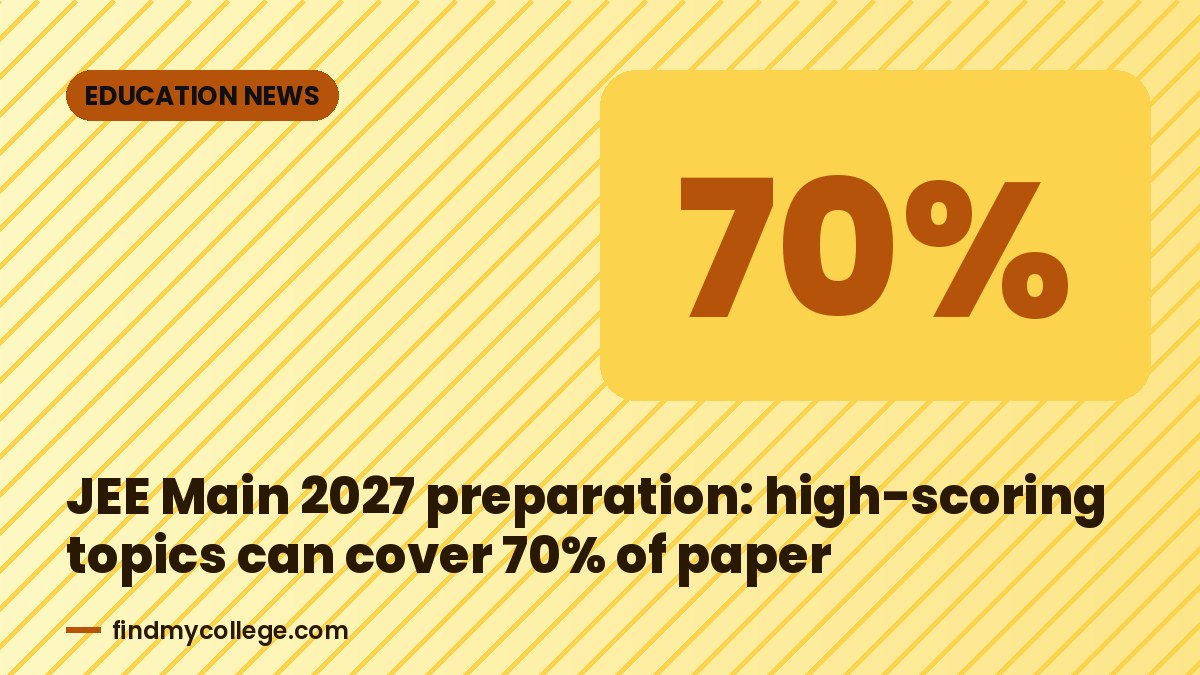
- High-weightage chapters are observed to contribute nearly 70% of the complete JEE Main paper.
- Matrix JEE Academy reported over 342 students clearing JEE Main 2026 with above 99 percentile.
- Solving and analyzing 10-15 years of JEE Main Previous Year Questions (PYQs) is recommended for preparation.
- The JEE Main exam pattern post-2024 shows an increase in multi-concept and application-based questions.
JEE Main aspirants are focusing on strategic preparation for the upcoming 2027 examination, with an emphasis on high-scoring topics and efficient study methods. Analysis from educational institutions suggests that concentrating on approximately 40% of the syllabus can potentially lead to high scores, including up to 100 percentile, by targeting specific high-weightage chapters.
This approach comes as the National Testing Agency (NTA) has modified the JEE Main exam pattern post-2024, introducing more multi-concept and application-based questions. The JEE Main syllabus is extensive, consisting of 64 chapters divided into 26 for Chemistry, 16 for Physics, and 22 for Mathematics, if you look at vedantu.com.
Strategic Subject Focus and High-Scoring Areas
Chemistry has been identified as the most scoring subject for JEE Main 2027, largely due to the dominance of NCERT material in this section, as observed by Matrix JEE faculty. NCERT revision is particularly highlighted for covering most of the Chemistry section questions. Stoichiometry is noted as an important topic within physical chemistry for the exam.
For Physics, high-scoring topics for JEE Main 2026 included Electrostatics and Optics, with specific mentions of Logic Gates (Electronic Devices), Lens Maker’s formula (Optics), Adiabatic process (Thermodynamics), and Projectile Motion (Kinematics). In Chemistry, key high-scoring topics for JEE Main 2026 included Mole Concept And Molar Mass (Some Basic Concepts in Chemistry), Crystal Field Splitting in Octahedral Field (Co-ordination Compounds), and Carbocations (Some Basic Principles of Organic Chemistry). Mathematics high-scoring topics for JEE Main 2026 included Linear Differential Equation (Differential Equations), Area Bounded by Two Curves (Integral Calculus), and Centroid (Co-ordinate Geometry).
Exam Pattern and Preparation Recommendations
A 5-year JEE Main paper trend analysis (2021-2026) by Matrix JEE faculty indicates Mathematics as consistently the toughest and longest section. Physics is generally observed to be of moderate difficulty, with repeated questions frequently appearing from Mechanics, Modern Physics, and Current Electricity. The JEE Main Session 1 is anticipated to be moderately difficult but lengthy, with most questions expected to be application-based.
An effective strategy for JEE Main involves attempting 50-60% of the paper with a 90% accuracy rate. High-weightage chapters are reported to contribute almost 70% of the complete JEE Main paper. Aspirants are advised to solve and analyze 10-15 years of JEE Main Previous Year Questions (PYQs). Mock tests are considered crucial for preparation, and maintaining an error log is a common practice among Matrix toppers. Recommended books for JEE Main 2027 preparation include DC Pandey (problem-oriented) and HC Verma (conceptual), with TS Grewal suggested for those targeting government institutes.
Performance Benchmarks and Success Stories
Matrix JEE Academy reported that over 342 of its students cleared the JEE Main exam with above 99 percentile in 2026. Among these, Sahil achieved a 99.987 percentile and an All India Rank (AIR) of 267 in JEE Main 2026. These results underscore the potential for high achievement through focused preparation.
For JEE Main 2027 Session 2, target percentiles by marks range indicate that scores between 280-300 are generally achieved by toppers, aiming for a 100 percentile. A score range of 250-279 typically corresponds to 99.95+ percentile, often achieved by strong droppers. For Class 12th students, 215-249 marks are associated with 99.7-99.9 percentile, while 190-214 marks provide a 97+ safety for qualifiers, aiming for 99.4-99.7 percentile. A minimum viable score for 99-99.4 percentile is considered to be in the 170-189 range.
| Marks Range | Percentile | Session 2 Target (Realistic) |
|---|---|---|
| 280-300 | 100 | Toppers only: 260+ baseline |
| 250-279 | 99.95+ | 99.5+ from strong droppers |
| 215-249 | 99.7-99.9 | 98-99 from Class 12th |
| 190-214 | 99.4-99.7 | 97+ safety for Qualifiers |
| 170-189 | 99-99.4 | Minimum viable |
Further reading

📰 More Education News
- Utkal University exam leak: police complaint filed, internal inquiry launchedSep 19, 2026 • Nishit Kumar
- TG LAWCET 2026: Exercise web options by Sep 21; report to college by Sep 29Sep 19, 2026 • Nishit Kumar
- MHT CET 2027 Phase 1 exam likely in December; what changes for aspirantsSep 19, 2026 • Nishit Kumar
- NEET UG 2026: Float candidates, upload documents by August 31, 2 PMSep 19, 2026 • Nishit Kumar