CBSE Class 12 Sociology sample paper 2026-27 released: what changes for board exam aspirants
In short
- The CBSE Class 12 Sociology sample paper for 2026-27, along with solutions and marking schemes, is available on the CBSE Academics Unit website and other platforms.
- The theory paper carries 80 marks and is of 3 hours duration, while internal project work accounts for 20 marks, totaling 100 marks.
- The question paper is divided into four sections, comprising 35 compulsory questions, including MCQs, very short answer, short answer, and long answer types.
- The exam pattern includes 20% MCQs, 30% competency-based questions, and 50% short and long answer questions.
- Students are advised to download the sample papers and practice solving them under timed conditions to prepare for the upcoming board exams.
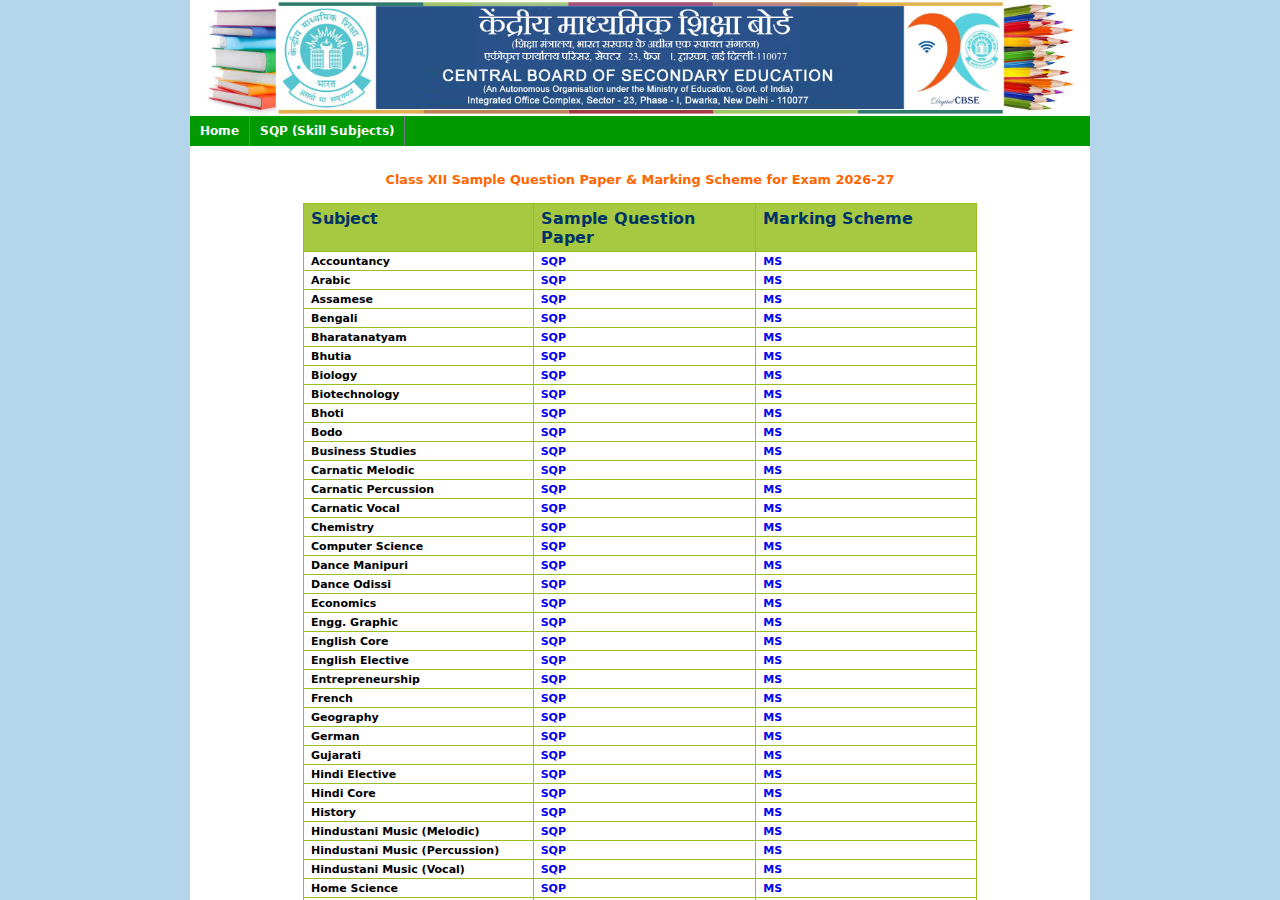
The Central Board of Secondary Education (CBSE) has released the Class 12 Sociology sample question paper and its corresponding marking scheme for the 2026-27 board examinations. This release, made available on the CBSE Academics Unit website and other educational platforms, aims to assist students in preparing for the upcoming board exams by familiarizing them with the question formats, section-wise weightage, and difficulty level.
The sample papers are designed in accordance with the latest syllabus, updated exam pattern, and revised marking scheme issued by CBSE. The overall exam structure for Sociology remains unchanged from the 2024-25 and 2025-26 academic sessions, but the nature of questions has shifted towards competency-based learning, source interpretation, and historical analysis.
CBSE Class 12 Sociology Exam Structure and Marking Scheme
The CBSE Class 12 Sociology theory paper carries a total of 80 marks and has a duration of 3 hours. An additional 20 marks are allocated for internal project work, bringing the grand total for the subject to 100 marks. The internal project assessment is divided into four stages: initiation and planning (5 marks), data collection and organisation (6 marks), data analysis and conclusion (5 marks), and a final viva-voce (4 marks).
The Sociology syllabus is split into two books, each carrying 40 marks: ‘Indian Society’ and ‘Social Change and Development in India’. The syllabus is further divided into three parts: Ancient, Medieval, and Modern Indian Sociology. The marks distribution for the theory paper is detailed below:
| Particulars | Marks |
|---|---|
| Themes in Indian Sociology – Part I | 25 |
| Themes in Indian Sociology – Part II | 25 |
| Themes in Indian Sociology – Part III | 25 |
| Map Work | 5 |
| Total Theory | 80 |
| Project Work (Internal Assessment) | 20 |
| Grand Total | 100 |
Question Paper Pattern and Types
The Class 12 Sociology question paper is divided into four sections, comprising a total of 35 compulsory questions. Section A includes question numbers 1-16, which are multiple-choice questions (MCQ). Section B contains question numbers 17-25, consisting of very short answer type questions, each carrying 2 marks, with answers not exceeding 30 words. Section C covers question numbers 26-32, which are short answer type questions, each worth 4 marks, with answers not exceeding 80 words. Section D includes question numbers 33-35, which are long answer type questions, each carrying 6 marks, with answers not exceeding 200 words. Notably, question number 33 in Section D requires an answer based on given graphics, with a passage-based alternative provided for visually impaired candidates.
The exam pattern generally allocates 20% weightage to MCQs, 30% to competency-based questions, and 50% to short and long answer questions. The paper includes a mix of objective, short-answer, long-answer, source-based, and map-based questions, with map-based questions specifically carrying 5 marks. The latest sample paper for 2026-27 indicates an increased focus on historical interpretation, moving beyond mere factual recall. Source-based questions, often derived from NCERT extracts, constitute a significant portion of the paper, and questions related to historical sources and writings of travelers like Al-Biruni, Ibn Battuta, and Bernier appear regularly. Ancient Indian Sociology topics frequently feature in MCQs and short-answer questions.
| Question Type | Skills Tested | Marks |
|---|---|---|
| MCQs | Conceptual understanding and factual knowledge | 21 |
| Short Answer Questions | Historical explanation and interpretation | 18 |
| Long Answer Questions | Analysis, argument building, and historical reasoning | 24 |
| Source-Based Questions | Interpretation of historical sources and evidence | 12 |
| Map-Based Questions | Historical locations, sites, and events | 5 |
| Component | Weightage | Description |
|---|---|---|
| MCQs | 20% | Objective-type questions including single correct answers |
| Competency-Based Questions | 30% | Case-based, source-based, assertion-reason, and application-based questions |
| Short & Long Answer Questions | 50% | Descriptive type questions testing conceptual clarity and explanation |
Resources for Preparation
The CBSE Class 12 Sociology sample paper and marking scheme for 2026-27 are available on the CBSE Academics Unit website (cbseacademic.nic.in) and other educational platforms such as Vedantu, Futuretopper, Selfstudys, Oswaalbooks, and Amazon.in. These resources are designed to help students understand the latest syllabus, exam pattern, and marking scheme. The assessment scheme for the Academic Session 2024-25 was continued for Sociology (039) in the 2025-26 session, and this continuity extends to the 2026-27 exams.
Several publishers are also offering preparation materials aligned with the new pattern. For instance, Oswaal Books provides 15 full-length sample papers for each subject, including Sociology, for the 2027 Board Exams, featuring 50% competency-based questions. Arihant offers ‘All in One Sociology Class 12 for CBSE Exam 2026-27’ and ‘i Succeed CBSE 10 Sample Question Papers Sociology Class 12 For Exam 2026’. Students are advised to download subject-wise sample papers and begin focused preparation. It is recommended to solve at least 5 to 7 full-length sample papers per subject, attempting them in one sitting with a 3-hour timer to simulate real board exam conditions.

Further reading
📰 More Education News
- IIBS Bangalore MBA fee structure 2027 released: check full payment breakdownSep 25, 2026 • Nishit Kumar
- IIM Bangalore EPGP 2027 round 2 admissions open: apply by November 25Sep 25, 2026 • Nishit Kumar
- FMGE October 2026 registration closes today: apply by 11:55 PMSep 25, 2026 • Nishit Kumar
- RRB NTPC undergraduate CBT 2 answer key out: raise objections by 30 SeptemberSep 25, 2026 • Nishit Kumar