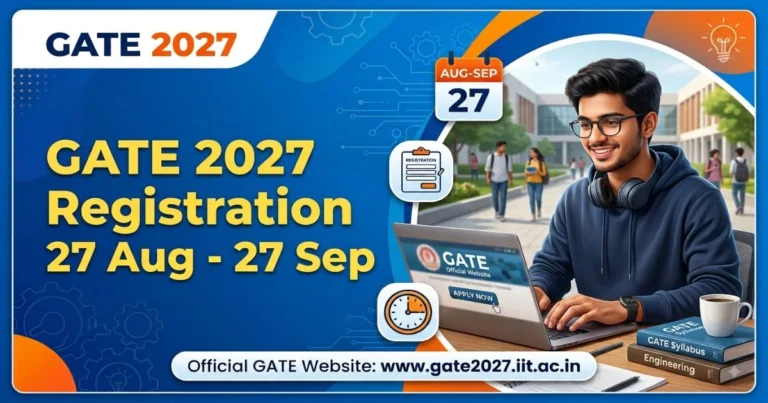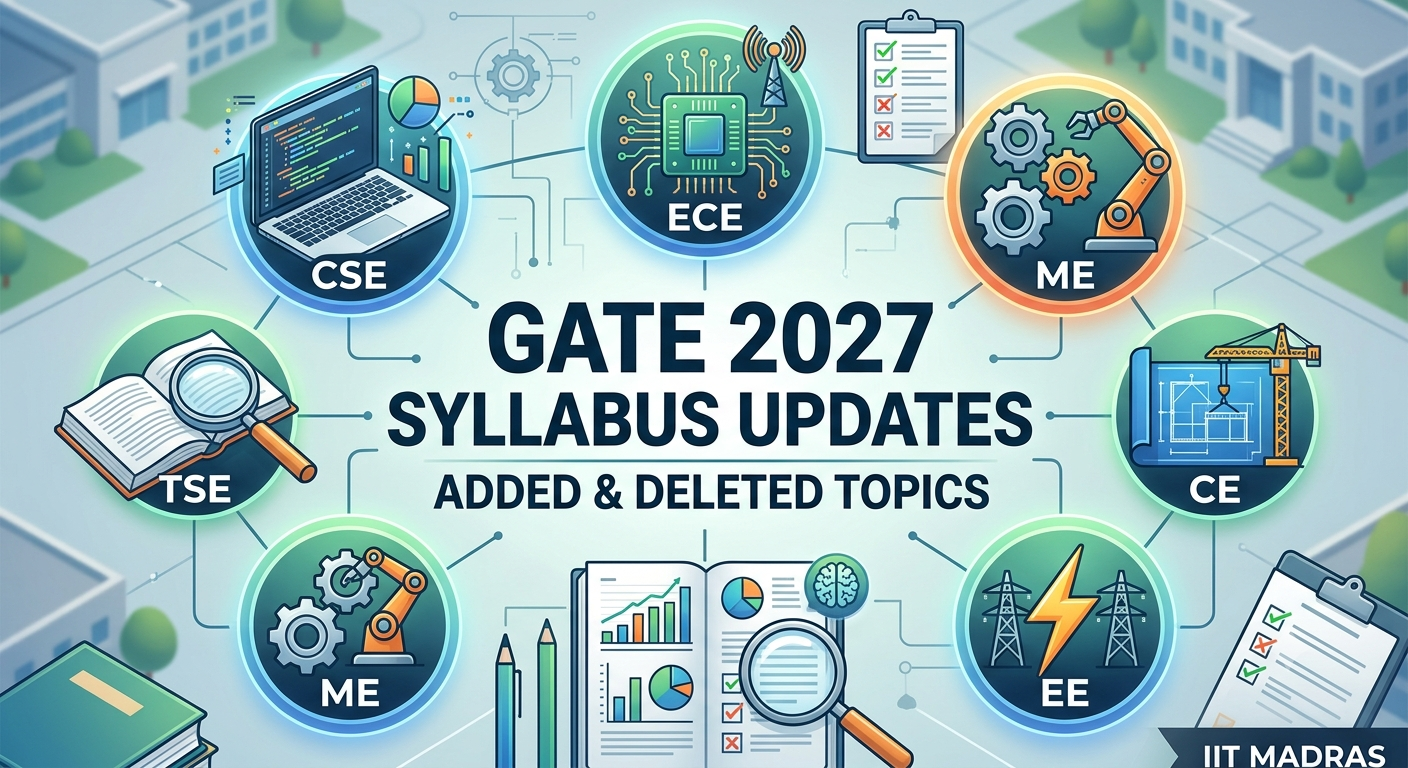
GATE 2027 Syllabus Updates: Complete List of Added and Deleted Topics for CSE, ECE, ME, CE, DA & EE
As the organizing body for the Graduate Aptitude Test in Engineering (GATE), Indian Institute of Technology (IIT) Madras has rolled out key updates to the examination framework and paper syllabi. These adjustments aim to align technical assessments with emerging industry demands, shifting academic focus toward modern computing architectures, automation, and sustainable engineering technologies.
While core engineering principles remain foundational across major streams, targeted additions, deletions, and structural realignments reflect a distinct pivot toward data-driven design and interdisciplinary application.
Key Stream Revisions: Added and Refined Focus Areas
1. Computer Science and Engineering (CSE)
The Computer Science syllabus places heightened emphasis on distributed architecture and practical computing paradigms.
-
Key Additions & Refinement: Core subjects like Computer Networks and Computer Organization & Architecture (COA) have been updated to explicitly cover cloud infrastructure components, modern instruction pipelines, and distributed systems logic. Machine learning fundamentals have also seen deeper integration alongside standard algorithms.
-
Deletions & Simplifications: Outdated micro-architectural protocols and redundant legacy networking concepts have been trimmed to focus heavily on modern software engineering contexts.
2. Data Science and Artificial Intelligence (DA)
Introduced as an independent paper, the DA stream has matured with a refined evaluation scope.
-
Key Additions: Deep learning architectures, large-scale data processing techniques, and comprehensive model evaluation metrics are now prominent. Coverage of statistical inference and matrix operations is more strictly defined to match real-world data science pipelines.
-
Deletions: Generic computing logic and basic algorithmic theory that do not directly serve data modelling or analytics have been de-emphasized.
3. Electronics and Communication Engineering (ECE)
The ECE syllabus modernizes digital signal processing and high-frequency design.
-
Key Additions: Explicit topics in signal processing now feature Finite Impulse Response (FIR) and Infinite Impulse Response (IIR) filter design. In Analog Circuits, dominant-pole (Miller) compensation and phase margin are formally integrated into the operational amplifier syllabus, alongside Proportional-Integral-Derivative (PID) controllers in Control Systems.
-
Deletions: Older discrete-time processing approaches for continuous-time signals have been trimmed, refocusing the sampling section specifically around the Nyquist sampling theorem, sampling, and reconstruction.
4. Electrical Engineering (EE)
Electrical Engineering pivots toward modern power distribution and clean energy solutions.
-
Key Additions: Power systems coverage expanded to include renewable energy grid integration, smart grid concepts, and updated solid-state drive controls within power electronics.
-
Deletions: Classical, heavy-machinery analysis topics with limited application in modern power grids have seen reduced weightage or removal.
5. Mechanical Engineering (ME)
Mechanical Engineering incorporates modern production techniques and thermal sustainability.
-
Key Additions: Additive manufacturing (3D printing), advanced material processing, and sustainable engineering design principles are now included.
-
Deletions: Traditional manufacturing methodologies and overly complex manual calculations in classical thermodynamics have been streamlined to prioritize digital manufacturing workflows.
6. Civil Engineering (CE)
Civil Engineering expands focus on modern survey and environmental management technologies.
-
Key Additions: Structural dynamics, modern geomatics techniques (including remote sensing/GIS integration), and updated environmental engineering standards for waste management.
-
Deletions: Older surveying practices and obsolete empirical structural design formulas have been phased out in favor of computational mechanics principles.
Structural Papers and Interdisciplinary Changes
In addition to branch-level updates, overall paper organization reflects broader educational trends:
Introduction of Robotics & Automation (RA): Launched as a standalone paper, RA bridges mechanical design, embedded electronics, real-time control, and computer vision. Candidates from ME, ECE, EE, and CSE can leverage this paper to target multidisciplinary master’s programs and research roles.
Merging of Legacy Papers: Independent standalone streams like Textile Engineering (TF) have been integrated as sectional subjects under broader frameworks such as Engineering Sciences (XE).
Exam Pattern at a Glance
The core structure of the test paper remains standardized across disciplines:
| Section | Target Area | Marks Weightage |
| General Aptitude (GA) | Verbal, Quantitative, Analytical & Spatial Ability | 15% (15 Marks) |
| Engineering Mathematics | Linear Algebra, Calculus, Differential Equations | 13% – 15% (Where Applicable) |
| Core Subject Area | Stream-Specific Engineering Topics | 70% – 72% (85 Marks total) |
All test papers remain objective, consisting of Multiple Choice Questions (MCQ), Multiple Select Questions (MSQ), and Numerical Answer Type (NAT) questions across a 3-hour duration.
Preparation Roadmap for Candidates
-
Audit Existing Study Materials: Standard core textbooks remain relevant for foundational topics, but supplementary material is required for newly introduced topics like cloud architectures, additive manufacturing, or renewable integration.
-
Review Official PDFs: Candidates should download the exact subject syllabus PDF directly from the official portal (
gate2027.iitm.ac.in) to verify detailed sub-topic boundaries before starting a subject. -
Strategic Secondary Paper Selection: Utilize the relaxed two-paper combination rules effectively (e.g., pairing CSE with DA, or ME/ECE with the new Robotics & Automation paper) to maximize postgraduate opportunities.

Further reading
📰 More Education News
- Gujarat NEET 2026 stray round allotment out: report to colleges by deadlineOct 21, 2026 • Nishit Kumar
- CFA Level 3 August 2026 results announced; first-time candidates pass rate at 56%Oct 21, 2026 • Nishit Kumar
- MPPSC ADPO 2026: Download admit card Oct 21; Exam Nov 1Oct 21, 2026 • Nishit Kumar
- HPBOSE Class 9, 10: Register by Nov 16; correct forms Nov 17-25Oct 21, 2026 • Nishit Kumar