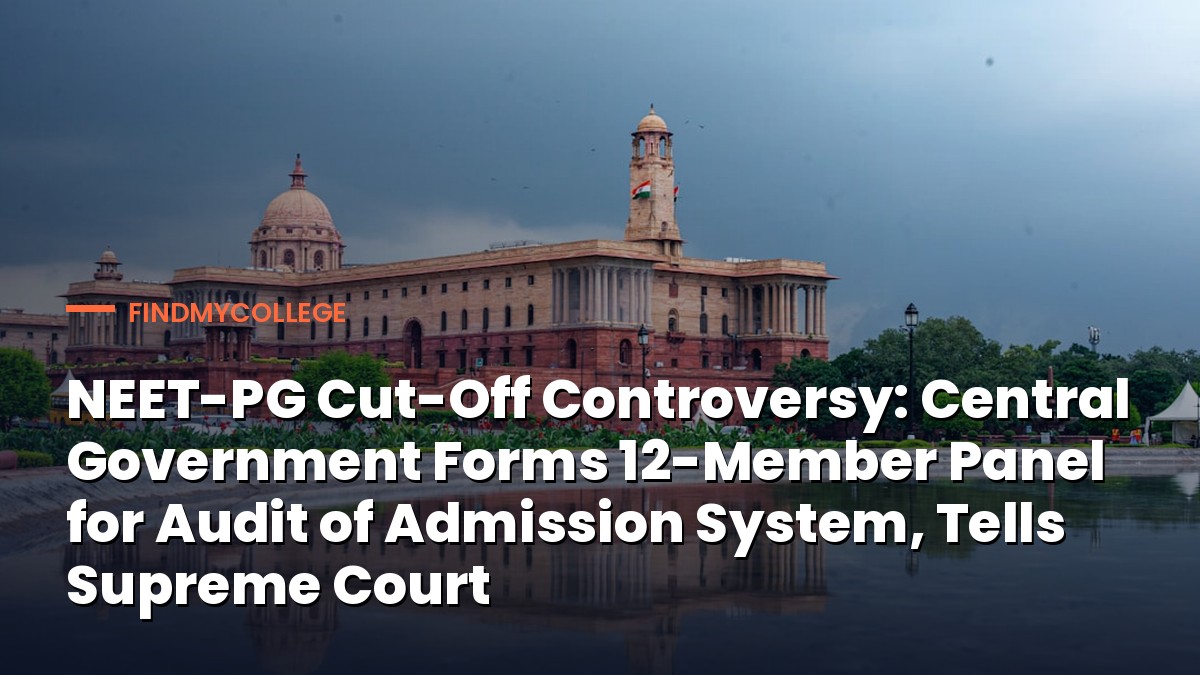
NEET-PG Cut-Off Controversy: Central Government Forms 12-Member Panel for Audit of Admission System, Tells Supreme Court
In a major development concerning postgraduate medical education in India, the Central Government has informed the Supreme Court that it has established a 12-member high-powered committee to carry out a comprehensive internal audit of the NEET-PG admission process.
The announcement came during the hearing of a batch of petitions challenging the government’s decision to sharply reduce the qualifying percentile cut-off for the NEET-PG examination. A Supreme Court bench comprising Justice P. S. Narasimha and Justice Alok Aradhe recorded the submission and directed the newly formed panel to submit its detailed findings within eight weeks.
Audit Panel to Review Admission Framework
Appearing for the Centre, Additional Solicitor General Aishwarya Bhati told the court that the government constituted the panel through an official notification issued on July 23. The committee is chaired by the Director General of Health Services (DGHS) and comprises medical experts and policy officials.
The primary mandate of the audit panel is to review the existing admission mechanism, spot systemic gaps, and suggest workable solutions to streamline the entire process. The Supreme Court also noted that the committee may co-opt members from the National Commission for Indian System of Medicine (NCISM) and the National Commission for Homeopathy (NCH) if broader consultation is needed.
The court stated that it would actively discuss the larger questions surrounding postgraduate admissions once the audit report is formally submitted.
The Trigger Behind the Legal Battle
The ongoing controversy stems from a notice issued earlier by the National Board of Examinations in Medical Sciences (NBEMS). The notification slashed the minimum qualifying cut-off for the third round of counselling for the academic year.
For general category candidates, the qualifying mark was dropped from the 50th percentile to the 7th percentile. This dramatic drop opened counselling eligibility to an additional 95,913 candidates across the country.
The move prompted several doctors and social workers to approach the apex court. Petitioners argued that drastically lowering the entrance standard degrades the quality of specialist healthcare in India. They contended that permitting candidates with near-zero percentile scores to secure seats in postgraduate programs violates Articles 14 and 21 of the Indian Constitution, which guarantee equality and the right to quality healthcare.
Government Defends Cut-Off Reduction
In a detailed affidavit submitted to the court, the Union Health Ministry defended the decision as a necessary administrative step taken in the public interest.
The government pointed out that out of approximately 70,000 available postgraduate seats, over 9,600 seats under the All-India Quota remained vacant after the second round of counselling. More than half of these empty seats were in government-run medical institutions built with public funds.
According to the Centre, reducing the cut-off was intended purely to prevent massive seat wastage rather than benefit private medical colleges. The government emphasized that similar percentile relaxations have been implemented in previous years—including an instance where the cut-off was lowered to zero—to ensure medical seats do not lie idle.
Furthermore, the Centre clarified that NEET-PG is not an examination designed to certify minimum medical competence. Because every candidate appearing for the test already holds a recognized MBBS degree and has completed a compulsory rotating internship, their basic clinical skill is already legally established. The NEET-PG exam functions primarily as a merit ranking test to allocate limited postgraduate seats among qualified doctors.
What Lies Ahead
While the Supreme Court recognized the government’s argument that NEET-PG candidates are already licensed doctors, it maintained that the long-term impact of lowering qualifying standards on medical education deserves careful examination.
With the eight-week deadline set for the DGHS-led audit committee, all eyes are now on the upcoming report. The panel’s findings are expected to play a decisive role in determining whether the current selection procedure will undergo structural reforms in the near future.


Further reading
📰 More Education News
- GATE 2027 registration ongoing: apply by 27 September without late feeSep 20, 2026 • Nishit Kumar
- Uttarakhand NEET counselling 2026 probe expands to all reserved categoriesSep 20, 2026 • Nishit Kumar
- AIAPGET 2026 score card released on September 18 for Ayush PG admissionsSep 20, 2026 • Nishit Kumar
- AP EAPCET 2026: Apply for pharmacy admissions in VisakhapatnamSep 20, 2026 • Nishit Kumar