NMAT 2026 exam scheduling deadline is October 22
In short
- Candidates must complete NMAT 2026 registration by October 10, 2026, to be eligible for exam scheduling.
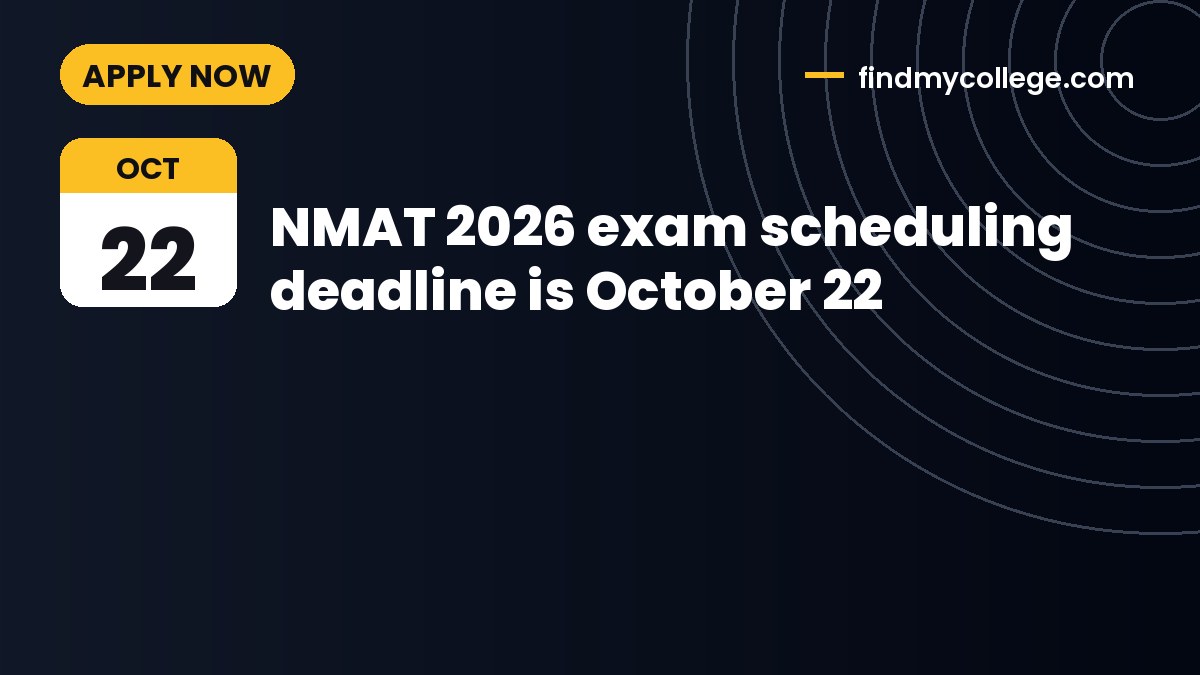
- The NMAT 2026 exam scheduling window, which opened on August 20, 2026, closes on October 22, 2026.
- The NMAT 2026 exam delivery window is scheduled from November 2, 2026, to December 20, 2026.
- The NMAT by GMAC™ exam can be attempted a maximum of three times within a single testing cycle.
- The registration fee for NMAT 2026 is INR 3,000 plus taxes for candidates in India.
The Graduate Management Admission Council (GMAC) has announced that the deadline for NMAT by GMAC™ exam scheduling for the 2026 testing cycle is October 22, 2026. Candidates seeking admission to MBA and master’s programs at NMAT accepting business schools must complete their slot booking by this date to select their preferred exam date, test timing, and exam delivery mode.
The NMAT by GMAC™ exam is a computer-adaptive online test accepted by 56 business schools across India and is taken over 75,000 times annually. Unlike the CAT exam, NMAT offers flexibility in choosing test dates and allows multiple attempts without negative marking. The registration window for NMAT 2026 opened on August 20, 2026, and will close on October 10, 2026, preceding the exam scheduling deadline.
NMAT 2026 Registration and Scheduling Process
To appear for the NMAT 2026 exam, candidates must first complete the registration process, which involves creating a user profile, entering personal and educational details, choosing colleges, uploading a photograph, and paying the test fee. Access to slot booking is contingent upon the successful submission of the application form and fee payment within the registration window.
Once registered, candidates can proceed to exam scheduling, which operates on a first-come, first-served basis. This step allows candidates to select when and where they will take the test, either at test centers across more than 80 cities in India or via an online proctored exam for those outside India. Both registration and scheduling are mandatory to receive the NMAT admit card and take the exam.
The NMAT 2026 exam delivery window is set from November 2, 2026, to December 20, 2026. The official NMAT score is typically sent within 48 hours of taking the exam, unless subject to audit. NMIMS, a prominent institution, accepts only the first valid NMAT score.
| Event | Start Date | End Date |
|---|---|---|
| NMAT 2026 Registration | 20-Aug-2026 | 10-Oct-2026 |
| NMAT 2026 Exam Scheduling | 20-Aug-2026 | 22-Oct-2026 |
| NMAT 2026 Exam Delivery Window | 02-Nov-2026 | 20-Dec-2026 |
| NMAT 2026 Rescheduling Window | 20-Aug-2026 | 17-Dec-2026 |
| NMAT Retake Registration | 03-Nov-2026 | 17-Dec-2026 |
| NMAT Retake Scheduling | 03-Nov-2026 | 17-Dec-2026 |
Exam Structure and Attempt Policy
The NMAT exam consists of three equally weighted sections: Language Skills, Quantitative Skills, and Logical Reasoning. Each section comprises 36 questions, contributing to a total of 108 questions. Candidates are allotted 120 minutes to complete the exam, with no negative marking. The overall score range for the NMAT exam is 36–360.
Candidates are permitted to take the NMAT by GMAC™ exam a maximum of three times within a single testing cycle, which includes a first attempt and up to two retakes. Retake payment and scheduling become available after a previous attempt. If a scorecard shows a valid score, the next exam date must be at least 7 days later. If a scorecard indicates ‘No Show’, ‘NDA Refused’, or ‘Exam Incomplete’, a new exam slot can be scheduled 24 hours later.
| NMAT 2026 Exam Overview | Details |
|---|---|
| Conducting Body | GMAC |
| Exam Name | NMAT by GMAC™ |
| Exam Level | National |
| Purpose | Admission to MBA and other management programmes |
| Exam Mode | Computer-Based Test (CBT) |
| Exam Window | Conducted over a multi-day testing window |
| NMAT Exam Dates 2026 | 2nd November to 20th December 2026 |
| Maximum Attempts | 3 attempts in one testing cycle |
| Retake Availability | Up to 2 retakes after the first attempt |
| Minimum Gap Between Valid Attempts | 7 days |
| Total Questions | 108 |
| Total Duration | 120 minutes |
| Number of Sections | 3 |
| Language Skills | 36 questions, 28 minutes, score range 12–120 |
| Quantitative Skills | 36 questions, 52 minutes, score range 12–120 |
| Logical Reasoning | 36 questions, 40 minutes, score range 12–120 |
| Overall Score Range | 36–360 |
| Section Order | Candidates can choose the order of attempting the three sections |
| Negative Marking | Not applicable |
Fees and Additional Services
The registration fee for the NMAT exam is INR 3,000 plus taxes for candidates in India, and $65 for international candidates. The retake fee is identical to the initial registration fee. A rescheduling fee of INR 1,200 plus taxes (or $30 internationally) applies if candidates need to change their booked slot. The registration fee includes sending scores to 5 business schools; additional score reports cost INR 400 plus taxes each (or $5 internationally).
| Initial Registration | ₹3,000 + Taxes |
| Retake | ₹3,000 + Taxes |
| Rescheduling | ₹1,200 + Taxes |
| Additional Score Report | ₹400 + Taxes |
Steps for Slot Booking
Candidates must log in to their official NMAT candidate account on the mba.com portal using their registered email ID and password. From the candidate dashboard, they should navigate to the exam application section and click the ‘Book Exam’ option next to their completed registration. The process involves selecting the test state, preferred city or test center location, an available test date within the delivery window, and a specific time slot. After reviewing all appointment details on the summary screen, candidates must confirm the booking to submit their NMAT by GMAC appointment request. A confirmation screen and email will be sent upon successful booking. The admit card can be downloaded from the Candidate Dashboard 7 days before the exam date.
Further reading

📰 More Education News
- GATE 2027 Environmental Science and Engineering syllabus released by IIT MadrasSep 27, 2026 • Nishit Kumar
- Ph.D. in Cloud Computing admissions 2026 open in Rajasthan; NIMS University offers part-time courseSep 27, 2026 • Nishit Kumar
- VITEEE 2026: Pay ₹5,900 counselling fee to participate in choice fillingSep 27, 2026 • Nishit Kumar
- GATE 2027 registration extended: apply with late fees by October 12Sep 27, 2026 • Nishit Kumar