GATE 2026 statistical report out: 19.6% pass rate, CS highest density
In short
- IIT Guwahati released the GATE 2026 Statistical Report on September 25, 2026, on its official portal.
- A total of 10,11,719 candidates registered for GATE 2026, with 797,434 appearing and 156,318 qualifying.
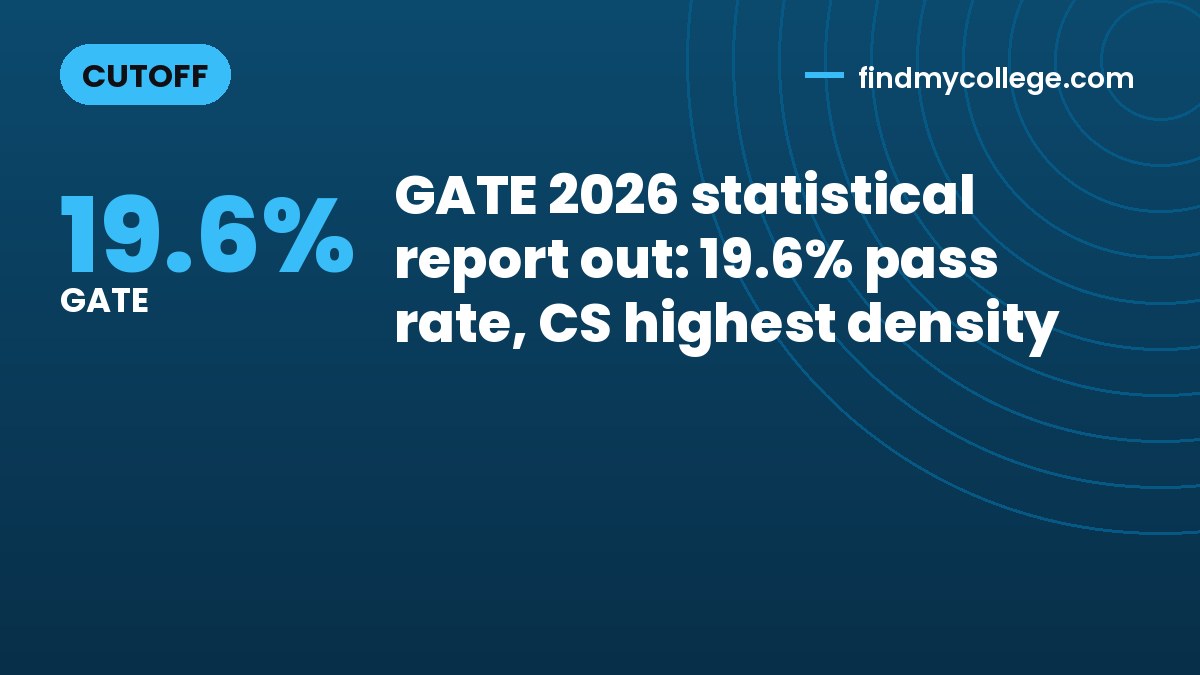
- The overall qualification rate for GATE 2026 stood at 19.6%, with Computer Science recording the highest candidate density.
- The report provides paper-wise cutoffs, with General category cutoffs for CS at 30 marks and Civil Engineering at 28.7 marks.
- Data Science & Artificial Intelligence emerged as a top-tier paper with 91,764 applicants.
IIT Guwahati, the organising institute for GATE 2026, published the Graduate Aptitude Test in Engineering (GATE) 2026 Statistical Report on September 25, 2026. The report, available on gate2026.iitg.ac.in, aims to provide complete transparency and key examination details for future GATE aspirants.
The complete document includes data on candidate registration, appearance, qualification rates, and paper-wise cutoffs. This release follows a pattern of previous GATE cycles, where statistical reports are issued by the respective organising institutes after the examination process concludes.
GATE 2026 Candidate Performance Overview
For GATE 2026, a total of 10,11,719 candidates registered, with 797,434 appearing for the examination held on February 7, 8, 14, and 15, 2026. Out of those who appeared, 156,318 candidates qualified, resulting in an overall pass rate of 19.6%.
Computer Science (CS) recorded the highest candidate density, with 259,922 registrations and 211,020 test-takers. Data Science & Artificial Intelligence (DA) also emerged as a significant paper, attracting 91,764 applicants. Metallurgical Engineering (MT) saw a candidate achieve the highest theoretical score of 100/100. Qualification rates across major engineering papers generally ranged between 15% and 20% of appeared candidates.
Paper-Wise Cutoffs and Admission Implications
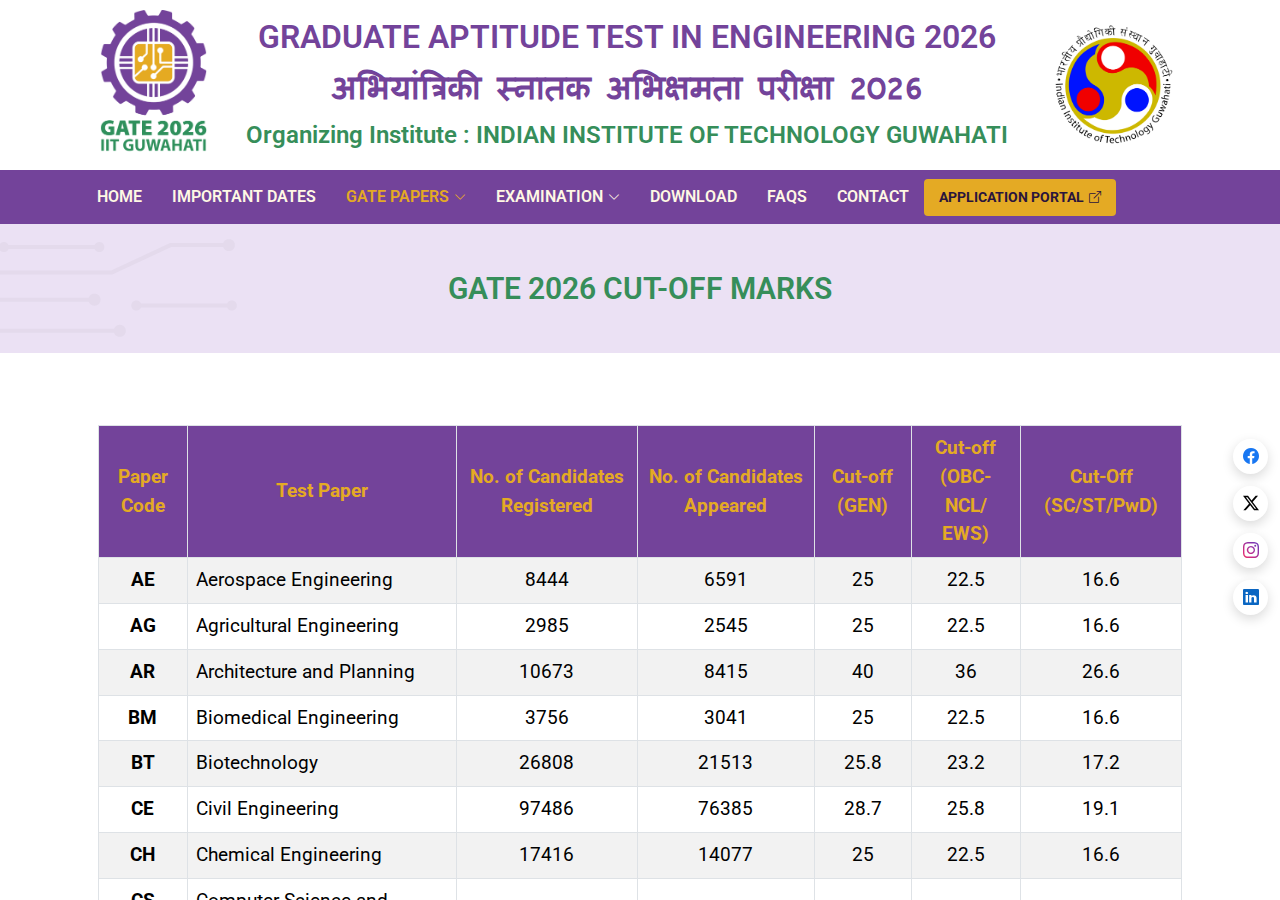
The GATE 2026 Statistical Report details paper-wise cutoffs for various categories. For Computer Science and Information Technology (CS), the cutoff for the General category was 30 marks, while for OBC-NCL it was 27 marks, and for SC/ST/PwD candidates it was 20 marks. Other notable General category cutoffs included Civil Engineering (CE) at 28.7 marks, Electrical Engineering (EE) at 27.7 marks, and Electronics and Communication Engineering (EC) at 26.4 marks. Several papers, including Architecture and Planning, Ecology and Evolution, Metallurgical Engineering, and Petroleum Engineering, had a qualifying cutoff of 40 marks for the General category.
A raw score of 50 in CS translates to a GATE score between 560 and 620, while a raw score above 70 in CS yields a GATE score over 770. A General category score of 600 is considered strong for admission options at top National Institutes of Technology (NITs). Required NIT cutoffs typically drop by 50 to 70 points for OBC candidates and by 100 to 130 points for SC and ST candidates.
| Test Paper | No. of Candidates Registered | No. of Candidates Appeared | No. of Qualified Candidates | General Cutoff | OBC/EWS Cutoff | SC/ST/PwD Cutoff |
|---|---|---|---|---|---|---|
| Aerospace Engineering | 8444 | 6591 | 1188 | 25 | 22.5 | 16.6 |
| Agricultural Engineering | 2985 | 2545 | 417 | 25 | 22.5 | 16.6 |
| Architecture and Planning | 10673 | 8415 | 2049 | 40 | 36 | 26.6 |
| Biomedical Engineering | 3756 | 3041 | 124 | 25 | 22.5 | 16.6 |
| Biotechnology | 26808 | 21513 | 3894 | 25.8 | 23.2 | 17.2 |
| Civil Engineering | 97486 | 76385 | 16604 | 28.7 | 25.8 | 19.1 |
| Chemical Engineering | 17416 | 14077 | 1933 | 25 | 22.5 | 16.6 |
| Computer Science and Information Technology | 259922 | 211020 | 21949 | 30 | 27 | 20 |
| Chemistry | 30775 | 22457 | 5428 | 25 | 22.5 | 16.6 |
| Data Science and Artificial Intelligence | 91764 | 69242 | 8377 | 26.4 | 23.7 | 17.5 |
| Electronics and Communication Engineering | 115448 | 95752 | 13260 | 26.4 | 23.7 | 17.5 |
| Electrical Engineering | 81947 | 65801 | 12596 | 27.7 | 24.9 | 18.4 |
| Environmental Science and Engineering | 7341 | 5107 | 1514 | 30 | 27 | 20 |
| Ecology and Evolution | 3659 | 2601 | 487 | 40 | 36 | 26.6 |
| Geomatics Engineering | 3582 | 2592 | 569 | 25 | 22.5 | 16.6 |
| Geology and Geophysics (Geology) | 5647 | 4336 | 1377 | 39.3 | 35.3 | 26.1 |
| Geology and Geophysics (Geophysics) | 668 | 519 | 252 | 37.1 | 33.3 | 24.7 |
| Instrumentation Engineering | 15608 | 12424 | 1978 | 39.8 | 35.8 | 26.5 |
| Mathematics | 16272 | 11561 | 2397 | 34.7 | 31.2 | 23.1 |
| Mechanical Engineering | 76823 | 59612 | 11922 | 25.2 | 22.6 | 16.7 |
| Mining Engineering | 8415 | 6732 | 1344 | 29.5 | 26.5 | 19.6 |
| Metallurgical Engineering | 4794 | 3908 | 723 | 40 | 36 | 26.6 |
| Naval Architecture and Marine Engineering | 548 | 419 | 70 | 33.7 | 30.3 | 22.4 |
| Petroleum Engineering | 1428 | 1137 | 386 | 40 | 36 | 26.6 |
| Physics | 24225 | 18055 | 4431 | 25.5 | 22.9 | 17 |
| Production and Industrial Engineering | 4849 | 3673 | 748 | 36 | 32.4 | 24 |
| Statistics | 3333 | 2087 | 339 | 30.4 | 27.3 | 20.2 |
| Textile Engineering and Fibre Science | 1549 | 1183 | 278 | 31.5 | 28.3 | 21 |
| Engineering Sciences | 12622 | 9099 | 2379 | 35.2 | 31.6 | 23.4 |
| Humanities and Social Sciences (Economics) | 4166 | 2952 | 548 | 35.7 | 32.1 | 23.8 |
| Humanities and Social Sciences (English) | 5350 | 3711 | 880 | 40 | 36 | 26.6 |
| Humanities and Social Sciences (Linguistics) | 383 | 285 | 59 | 37.4 | 33.6 | 24.9 |
| Humanities and Social Sciences (Philosophy) | 800 | 570 | 84 | 38.3 | 34.4 | 25.5 |
| Humanities and Social Sciences (Psychology) | 8858 | 6178 | 809 | 39.3 | 35.3 | 26.1 |
| Humanities and Social Sciences (Sociology) | 2643 | 1819 | 266 | 40 | 36 | 26.6 |
| Life Sciences | 50732 | 40035 | 7787 | 36.3 | 32.6 | 24.1 |
People Also Read




Comparison with Previous GATE Cycles
The GATE 2026 examination cycle saw an increase in registered candidates compared to the previous year. For GATE 2025, IIT Roorkee announced results with 9.3 lakh registered students, 6.5 lakh appeared, and 1.3 lakh qualified, marking an 18% pass percentage. This indicates a slight increase in both registration and the overall qualification rate for GATE 2026.
The GATE cutoff marks are known to fluctuate annually, influenced by factors such as the difficulty level of the paper, the total number of applicants, the overall performance of candidates, and the availability of MTech, PhD, or PSU seats. The release of these statistical reports aims to provide a clear benchmark for candidates preparing for future GATE examinations.
| Year | Total Registered | Total Appeared |
|---|---|---|
| 2025 | 9,36,019 | 7,47,319 |
| 2024 | 8,26,239 | 6,53,292 |
| 2023 | 6,70,000 | 5,17,000 |
| 2022 | 8,00,000 | 7,11,542 |
| 2021 | 10,00,000 | 8,50,000 |
Further reading






📰 More Education News
- NEET re-exam score drop shatters international athlete’s medical dreamSep 27, 2026 • Nishit Kumar
- CCMT 2026: Physical report to allotted institutes by August 18Sep 27, 2026 • Nishit Kumar
- SLAT 2027 registration active: apply by December 4 for law programmesSep 27, 2026 • Nishit Kumar
- BHMCT Ranchi 2026: Apply for entrance exams, then attend counsellingSep 27, 2026 • Nishit Kumar