GATE 2027: Register now; exam held for six days
In short
- IIT Madras is conducting the GATE 2027 examination, which will be held for six days across India.
- Registrations for GATE 2027 are currently ongoing, with exam dates already released.
- Changes have been implemented in the GATE syllabus for 2027, and DigiLocker is being used in the application process.
- The GATE exam is conducted by different IITs and IISc on a rotational basis annually for MTech admissions and PSU jobs.
- The GATE examination is known for maintaining a consistent difficulty level over the past 10 to 15 years.
The Indian Institute of Technology Madras (IIT Madras) is conducting the Graduate Aptitude Test in Engineering (GATE) 2027, with exam dates announced and registrations currently underway. The examination will be held for six days across India, supporting postgraduate admissions to highly reputed institutions and jobs in premier public sector organizations.
The GATE exam, a Computer Based Test (CBT) conducted in English, is a crucial assessment for millions of candidates annually. For the 2027 edition, IIT Madras has implemented changes to the syllabus and introduced DigiLocker integration in the application form, according to official information.
GATE 2027 Examination Structure and Marking
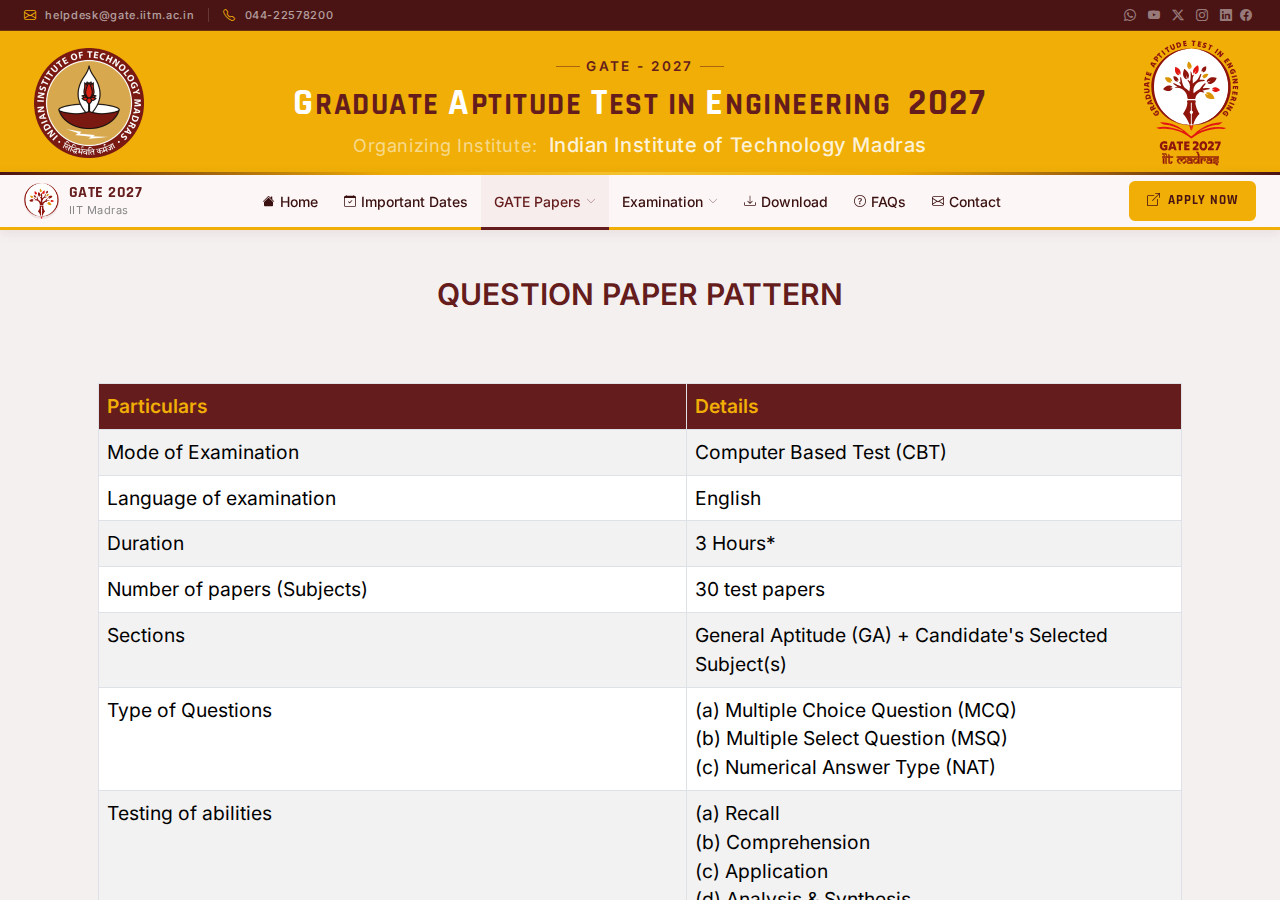
The GATE 2027 examination will comprise 30 test papers, each with a duration of three hours. The exam is divided into two sections: General Aptitude (GA) and the Candidate’s Selected Subject(s). Question types include Multiple Choice Questions (MCQ), Multiple Select Questions (MSQ), and Numerical Answer Type (NAT), designed to test abilities such as Recall, Comprehension, Application, and Analysis & Synthesis.
A total of 65 questions will be asked, with 10 questions from General Aptitude and 55 from the chosen subject. General Aptitude carries 15 marks in most papers. Engineering Mathematics accounts for 13 marks in most engineering papers, while Subject Questions carry 72 marks. However, in papers such as AR, CY, DA, EY, GE, GG, MA, PH, RA, ST, XH, and XL, Subject Questions carry 85 marks. Questions are either 1-mark or 2-marks. Negative marking applies only to MCQs: 1/3 mark is deducted for a wrong 1-mark MCQ answer, and 2/3 mark for a wrong 2-mark MCQ answer. There is no negative marking for MSQ or NAT questions, and no partial marking in MSQ.
| Particulars | Details |
|---|---|
| Mode of Examination | Computer Based Test (CBT) |
| Language of examination | English |
| Duration | 3 Hours* |
| Number of papers (Subjects) | 30 test papers |
| Sections | General Aptitude (GA) + Candidate’s Selected Subject(s) |
| Type of Questions | (a) Multiple Choice Question (MCQ) (b) Multiple Select Question (MSQ) (c) Numerical Answer Type (NAT) |
| Testing of abilities | (a) Recall (b) Comprehension (c) Application (d) Analysis & Synthesis |
| Number of questions | 10(General Aptitude) + 55(Subject) = 65 Questions |
| Distribution of Marks in all Papers EXCEPT AR, CY, DA, EY, GE, GG, MA, PH, RA, ST, XH, and XL | General Aptitude: 15 marks Engineering Mathematics**: 13 marks Subject Questions: 72 marks Total: 100 marks (**XE includes Engineering Mathematics section XE0 of 15 marks) |
| Distribution of Marks in papers AR, CY, DA, EY, GE, GG, MA, PH, RA, ST, XH, and XL | General Aptitude: 15 marks Subject Questions: 85 marks Total: 100 marks |
| Marking Scheme | Questions carry either 1 mark or 2 marks |
| Negative Marking | For a wrong answer chosen in an MCQ, there will be negative marking. For a 1-mark MCQ, 1/3 mark will be deducted for a wrong answer. For a 2-mark MCQ, 2/3 mark will be deducted for a wrong answer. There is no negative marking for wrong answer(s) to MSQ or NAT questions. There is no partial marking in MSQ. |
PwD candidates in certain categories may request one hour of compensatory time if they provide a valid disability certificate or UDID card, as per O.M. F. No. P-13013/75/2023-Policy-DD-III dated August 01, 2025.
Difficulty Level and Organizing IITs
The GATE exam is known for maintaining a consistent difficulty level over the past 10 to 15 years across all its disciplines and 30 papers. While the overall difficulty level of GATE 2025 was reported as moderate to slightly difficult, and GATE 2024, conducted by IISc Bangalore, was moderate, students often debate which older IITs prepare the toughest questions.
IISc Bangalore is frequently mentioned for setting the most difficult GATE papers, with questions designed to assess analytical skill research. Many students have also indicated that IIT Bombay creates challenging GATE question papers. IIT Bombay, IISc Bengaluru, and IIT Guwahati are noted for curating challenging GATE question papers. In 2019, when IIT Madras set the GATE Electrical paper, AIR 1 scored 97.33 out of 100, AIR 2 scored 97.00, and AIR 5 scored 95.67. The organizing IIT manages the GATE official website, coordinates exam centers, and calculates results. GATE is conducted by different IITs and IISc on a rotational basis every year; for example, IIT Guwahati organized GATE 2026, and IIT Roorkee administered the exam in 2025. Professors and senior faculty members from all IITs and IISc Bangalore pool their questions into a secure database for GATE.
| GATE Papers | Difficulty Level |
|---|---|
| GATE 2025 CE1 – Civil Engineering (Shifts 1 and 2) | Moderate to Difficult |
| GATE 2025 IN (Instrumentation Engineering) | Moderate |
| GATE 2025 CH (Chemical Engineering) | Moderate |
| GATE 2025 EE (Electrical Engineering) Paper | Difficult |
| GATE 2025 ECE (Electronics and Communication Engineering) Paper | Moderate |
| GATE 2025 CSE (Computer Science and Engineering) Paper | Moderate |
| GATE 2025 ME (Mechanical Engineering) Paper | Moderate to Difficult |
| GATE 2025 BM (Biomedical Engineering) Paper | Moderate |
| GATE 2025 CY (Chemistry) Paper | Easy to Moderate |
| GATE 2025 ES (Environmental Sciences) Paper | Easy to Moderate |
| GATE 2025 XH (Humanities and Social Sciences) Paper | Moderate |
| GATE 2025 AR (Architecture and Planning) Paper | Easy to Moderate |
Despite these perceptions, official statements indicate that no specific IIT is solely responsible for setting tough papers, and there is no particular conducting body that consistently sets the toughest paper. Instead, the focus remains on maintaining a consistent and standardized level of difficulty across all disciplines.
Further reading

📰 More Education News
- M.Pharm Industrial Pharmacy 2026: Apply with B.Pharm, 50-55% marks, pass entrance examSep 26, 2026 • Nishit Kumar
- Maitree Group BBA: Apply by Sep 25, 2026Sep 26, 2026 • Nishit Kumar
- GGV CUET UG 2026-27 common merit list and counselling schedule releasedSep 26, 2026 • Nishit Kumar
- M.Pharm PQA 2026: Apply for Hubali-Dharwad admissions via entrance examSep 26, 2026 • Nishit Kumar