SLAT GK 2027 syllabus, preparation tips released; apply by December 4
In short
- SLAT 2027 registration is currently active and will close on December 4, 2026.
- The SLAT GK section comprises 12 questions, contributing 12 marks and 20% of the total exam weightage.
- The General Knowledge section covers both Static GK and Current Affairs, requiring candidates to stay updated on national and international events.
- The computer-based SLAT 2027 exam will be conducted in two phases on December 19 and December 26, 2026.
- Candidates can attempt the SLAT exam twice, with the higher score being considered for admission.
Symbiosis International (Deemed University), Pune, has released the General Knowledge (GK) syllabus, preparation tips, and important topics for the Symbiosis Law Admission Test (SLAT) 2027. The SLAT GK section, which accounts for 20% of the total marks, consists of 12 questions, each carrying one mark.
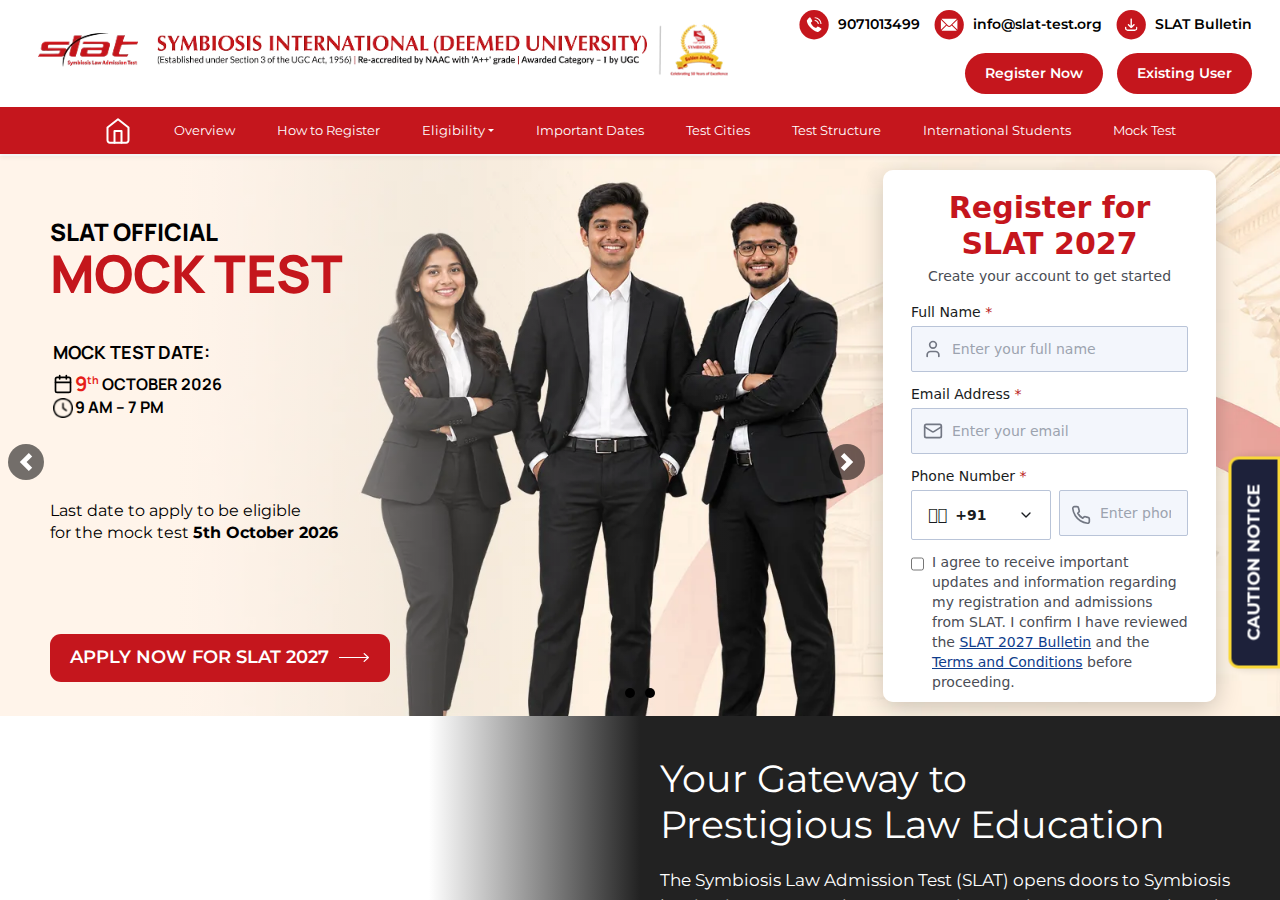
The SLAT 2027 registration commenced on August 21, 2026, and will conclude on December 4, 2026, which is also the deadline for application fee payment. The national-level, computer-based law entrance exam is scheduled to be held in two phases: the first on December 19, 2026, and the second on December 26, 2026.
SLAT 2027 Exam Structure and Key Dates
The SLAT 2027 exam is a 60-minute Computer-Based Test (CBT) comprising 60 multiple-choice questions, with 12 questions from each of the five sections. These sections include Logical Reasoning, Legal Reasoning, Analytical Reasoning, Reading Comprehension, and General Knowledge. Each correct answer fetches one mark, and there is no negative marking for incorrect responses. Candidates have the option to attempt the exam twice, with the higher score being considered for admission.
Admit cards for Test 1 will be released on December 11, 2026, followed by Test 2 admit cards on December 18, 2026. The results for SLAT 2027 are slated for announcement on January 12, 2027.
| Event | Date |
|---|---|
| SLAT 2027 Registration Start Date | August 21, 2026 |
| SLAT 2027 Registration Last Date | December 4, 2026 |
| Last Date for SLAT Application Fee Payment | December 04, 2026 |
| Admit Card Release – SET Test 01 | December 11, 2026 |
| Admit Card Release – SET Test 02 | December 18, 2026 |
| SLAT 2027 Exam Date – SET Test 01 | December 19, 2026 |
| SLAT 2027 Exam Date – SET Test 02 | December 26, 2026 |
| Announcement of SLAT 2027 Results | January 12, 2027 |
| Particulars | Details |
|---|---|
| Exam Name | SLAT (Symbiosis Law Admission Test) |
| Conducting Body | Symbiosis International (Deemed University) |
| Exam Mode | Online |
| Type of Questions | Multiple-choice questions |
| Total Duration | 60 minutes |
| Total Number of Questions | 60 |
| Total Marks | 60 |
| Marking Scheme | +1 for each correct answer |
| Negative Marking | No negative marking for wrong answer |
General Knowledge Syllabus and Important Topics
The General Knowledge section of SLAT 2027 is divided into Static GK and Current Affairs. Current Affairs topics include national and international events, state affairs, government schemes, awards and honours, books and authors, agreements and deals, sports, science and defence, summits and conferences, current economy, and appointments. Static GK covers History (Ancient, Medieval, Modern, and World), Geography, National Parks and Wildlife Sanctuaries, Arts and Culture, General Science, Headquarters of National and International Organisations, Economy, Currency, and Capital.
The GK section is considered a crucial component, offering potential for high scores due to its factual nature and time-efficiency. Candidates are advised to start their GK preparation early to cover the extensive syllabus and stay updated with daily news.
| Topic | Key Areas |
|---|---|
| National & International Affairs | Major events, government initiatives |
| State Affairs | State policies, developments |
| Government Schemes | Central & state programs |
| Awards & Honours | Recognitions |
| Books & Authors | Famous publications |
| Agreements & Deals | Bilateral & multilateral pacts |
| Sports | Tournaments, winners |
| Science & Defence | ISRO, DRDO, discoveries |
| Summits & Conferences | International gatherings |
| Current Economy | Reports, indices |
| Appointments | National & global appointments |
| Static GK (History, Geography, etc.) | Ancient–Modern History, Physical & Political Geography, National Parks, Arts & Culture, General Science, Headquarters, Economy, Currency, Capital |
Preparation Strategies for General Knowledge
For effective preparation, candidates are encouraged to develop a daily habit of reading newspapers and following daily news updates. Referring to magazines such as Chronicle, Pratiyogita Darpan, and Competition Success Review can also aid in Current Affairs preparation. Consistent revision of Static GK and maintaining concise notes are recommended. Regular practice through GK quizzes and section-wise tests, followed by performance review, is also advised.
During the exam, it is suggested that candidates do not spend more than 10 minutes on the GK section. A three-cycle method for attempting the GK section involves first identifying easy questions, then attempting questions requiring more thought, and finally addressing any remaining questions by eliminating options.
| Section | Name of the Book |
|---|---|
| General Knowledge | Newspapers, Manorama Year Book, Law Magazines |
| Reading Comprehension | Objective General English by RS Aggarwal |
| Logical Reasoning | A Modern Approach to Logical Reasoning by RS Aggarwal |
| Legal Reasoning | Legal Awareness and Legal Reasoning by Pearson |
| Analytical Reasoning | Analytical Reasoning by MK Pandey |
Further reading

📰 More Education News
- State CET Cell: Apply for B.Pharm/Pharm.D admissions via choice filling on fn.mahacet.orgSep 27, 2026 • Nishit Kumar
- Ph.D. Computer Science admissions open in Rajasthan; apply by Sep 24, 2025Sep 27, 2026 • Nishit Kumar
- GATE 2027: Register by Oct 5 for extended deadlineSep 27, 2026 • Nishit Kumar
- WB JEPBN 2026 round 3 choice filling closes today; seat allotment tomorrowSep 27, 2026 • Nishit Kumar