GATE 2027: Indian nationals, update DigiLocker & register by Sep 27
In short
- The regular registration window for GATE 2027 closes today, September 27, 2026, with an extended deadline until October 5, 2026, with late fees.
- Indian nationals are required to create and update a verified DigiLocker account for GATE 2027 registration, from which personal data will be fetched.
- Applicants must upload a recent passport-size photograph and a scanned signature conforming to specified dimensions and file sizes.
- A live photograph will be captured during registration using a webcam or phone camera for identity verification.
- The GATE 2027 examination will be conducted on February 6, 7, 13, 14, 20, and 21, 2027, introducing a new Robotics & Automation paper.
IIT Madras, the organizing institute for GATE 2027, has released detailed instructions for the upcoming Graduate Aptitude Test in Engineering (GATE) 2027 registration process. The regular registration period for GATE 2027 concludes today, September 27, 2026, with candidates still able to apply until October 5, 2026, by paying an extended fee. The guidelines, available on the official portal gate2027.iitm.ac.in, emphasize mandatory DigiLocker updation for Indian nationals, alongside specific requirements for photographs and signatures.
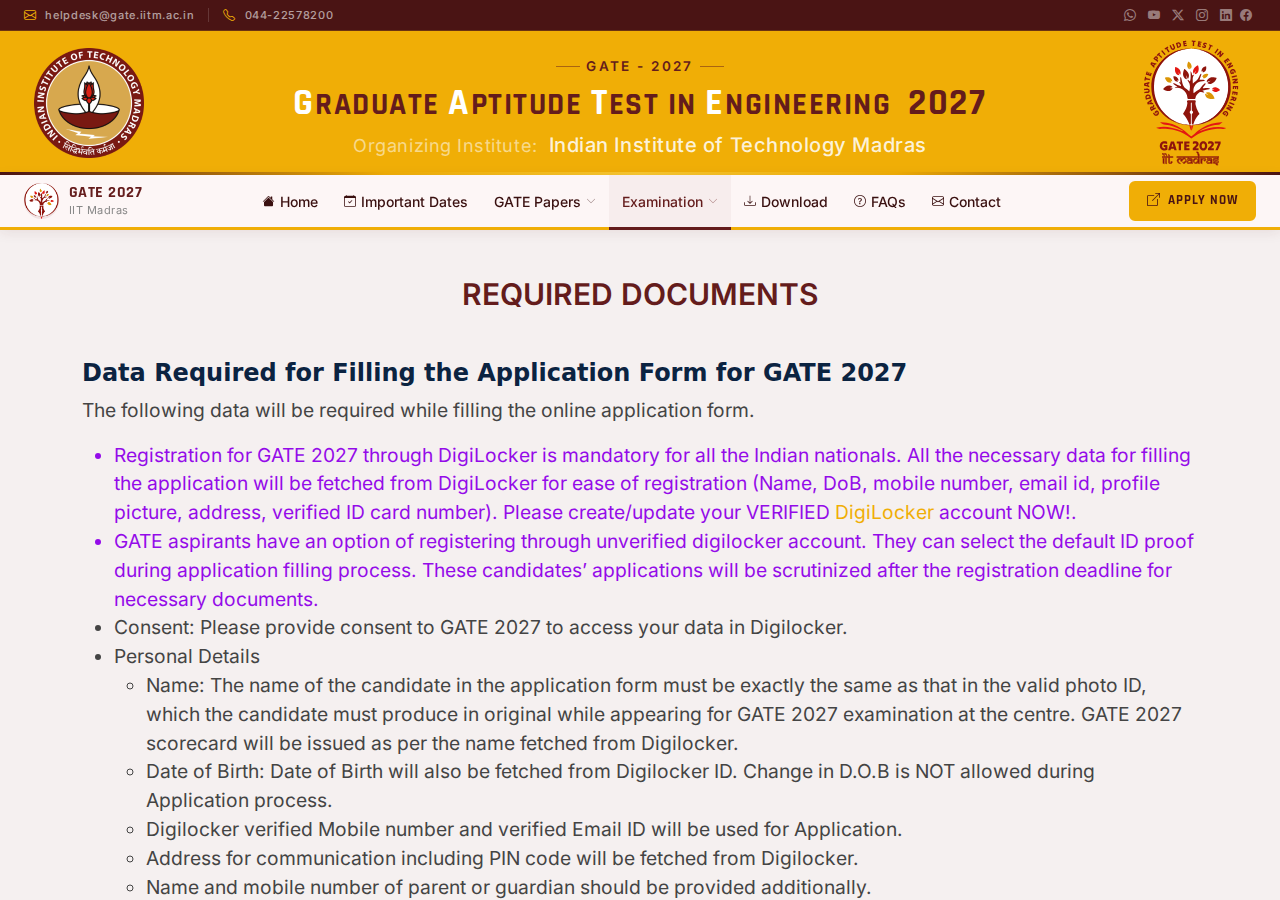
This year marks a significant change as registration through a verified DigiLocker account is compulsory for all Indian nationals, a first for the examination. The process aims to streamline verification and ensure data accuracy. Candidates are advised to ensure their DigiLocker accounts are updated and verified to support a smooth application.
Mandatory Digilocker Updation and Data Fetching
For GATE 2027, Indian nationals are required to create or update a DigiLocker account. This measure is intended to support a smooth registration and verification process. Essential applicant data, including name, date of birth, mobile number, email ID, profile picture, address, and verified ID card number, will be automatically fetched from the candidate’s DigiLocker account. The name of the candidate in the application form must precisely match the name on the valid photo ID, and the GATE 2027 scorecard will be issued based on the name retrieved from DigiLocker.
Candidates have the option to register through an unverified DigiLocker account, but their applications will undergo scrutiny after the deadline. If a mobile number is linked to multiple DigiLocker accounts, the system will prompt the candidate to select one. If both linked accounts are unverified, one must be verified first. A blue verification checkmark identifies a verified DigiLocker account. While the photo in Aadhaar card/DigiLocker will not be used for the GATE 2027 application, candidates can select a verified document from DigiLocker (Aadhaar, PAN, Driving Licence, or APAAR ID) to resolve any name or date of birth mismatches.
Photograph, Signature, and Id Proof Specifications
Applicants must upload a recent passport-size colour photograph and a scanned signature that adhere to strict specifications. The photograph should not be older than three months, be approximately 3.5 cm in width and 4.5 cm in height, with the face covering 60–70% of the image. It must have a plain white background, show a frontal view, and have the candidate looking straight at the camera, with clear forehead, eyes, nose, and chin. Normal vision spectacles are permitted, but caps, hats, sunglasses, tinted glasses, shadows, or other people are not allowed. The photograph must be in JPEG/JPG format, with an aspect ratio between 0.66 and 0.89, a minimum resolution of 200 × 260 pixels, a maximum of 530 × 690 pixels, and a file size between 5 kB and 600 kB.
The signature image must be handwritten in black or dark blue ink on plain white paper, also in JPEG/JPG format. The signature area should cover 70–80% of the image, with an aspect ratio (height:width) of 1:R where R is between 2.75 and 3.75. The resolution must be a minimum of 250 × 80 pixels and a maximum of 580 × 180 pixels, with a file size between 3 kB and 300 kB. A scanned valid ID proof, such as an Aadhaar card, PAN card, Passport, Voter ID, or Driving Licence, is also required. The same physical ID must be carried to the examination centre. Additionally, a live photo of the candidate will be captured during registration using a computer with a webcam or a phone with a minimum 5 MP front-facing camera for verification purposes.
Application Deadlines and Fees
The registration window for GATE 2027 is operating on a strict timeline, with the regular registration period concluding today, September 27, 2026. Candidates who miss this deadline have an opportunity to register with an extended fee until October 5, 2026. The application fees vary based on the candidate’s category and the registration period.
The fee is charged per test paper, meaning a two-paper combination will incur charges for both papers. Payment is exclusively online, accepted via net banking, UPI, debit, or credit card. OBC-NCL and EWS candidates are not required to upload a category certificate for fee concessions; only SC, ST, and PwD candidates need to do so.
| Events | Revised Dates |
|---|---|
| Opening of GATE GOAPS for registration | September 2, 2026 |
| Closing of GATE GOAPS for registration (with regular fees) | September 27, 2026 |
| Closing of GATE application form window (with extended fees) | October 5, 2026 |
| Category | Regular Period | Extended Period |
|---|---|---|
| Female/SC/ST/PwD category | INR 1000 | INR 1500 |
| All other candidates including foreign nationals | INR 2000 | INR 2500 |
Eligibility, Examination Structure, and New Papers
Any undergraduate student currently in their 3rd year or higher of any government-approved program in Engineering, Technology, Architecture, Science, Commerce, Arts, or Humanities is eligible to appear for GATE 2027. There is no age limit, and candidates can appear for the examination any number of times. One email address can be used to submit only one application form. Candidates previously limited to three exam-city preferences can now select up to six cities from the same zone.
The GATE 2027 examination will be held on February 6, 7, 13, 14, 20, and 21, 2027. A new test paper, Robotics & Automation (RA), has been introduced, increasing the total number of GATE papers to 30. Every paper’s syllabus has been updated for GATE 2027, including revisions for Biotechnology (BT) and updates to the classification of the Textile Engg. & Fibre Science (TF) paper. Sectional paper codes for Engineering, Humanities & Social Sciences, and Life Sciences have also been revised. Foreign nationals and NRIs must choose an examination city within India, as GATE 2027 will not be held outside the country.
Document Uploads for Specific Categories
While educational certificates are not required at the time of GATE 2027 registration, specific category certificates must be uploaded to DigiLocker in PDF format for applicable candidates. SC/ST category certificates, if applicable, must be named ‘CATEGORY.pdf’ within a folder named ‘GATE2027’. Similarly, a scanned copy of a UDID (preferred) or PwD Certificate, if applicable, must be uploaded to the ‘GATE2027’ folder, named ‘UDID_CERT.pdf’ or ‘PWD_CERT.pdf’.
For candidates claiming benefits for dyslexia, a scanned copy of Appendix-B1 or Appendix-B2 or a Dyslexic Certificate, compiled with the PwD certificate as a single PDF document, must be uploaded as ‘PWD_CERT.pdf’. General, OBC-NCL, and EWS candidates do not need to upload documents to the ‘GATE2027’ DigiLocker folder. academic documents such as 10th, 12th, undergraduate, or postgraduate mark sheets are not required during the examination process.
Further reading

📰 More Education News
- Chhattisgarh schools closed on Saturday due to heavy rain and flood-like situationSep 28, 2026 • Nishit Kumar
- GATE 2027 registration deadline today; DigiLocker verification mandatory for Indian nationalsSep 28, 2026 • Nishit Kumar
- GATE 2027 registration extended: apply by October 5 with regular feesSep 28, 2026 • Nishit Kumar
- GATE 2027 Environmental Science and Engineering syllabus released by IIT MadrasSep 27, 2026 • Nishit Kumar