JEE Main 2027 Session 1 exam dates announced: January 22-30
In short
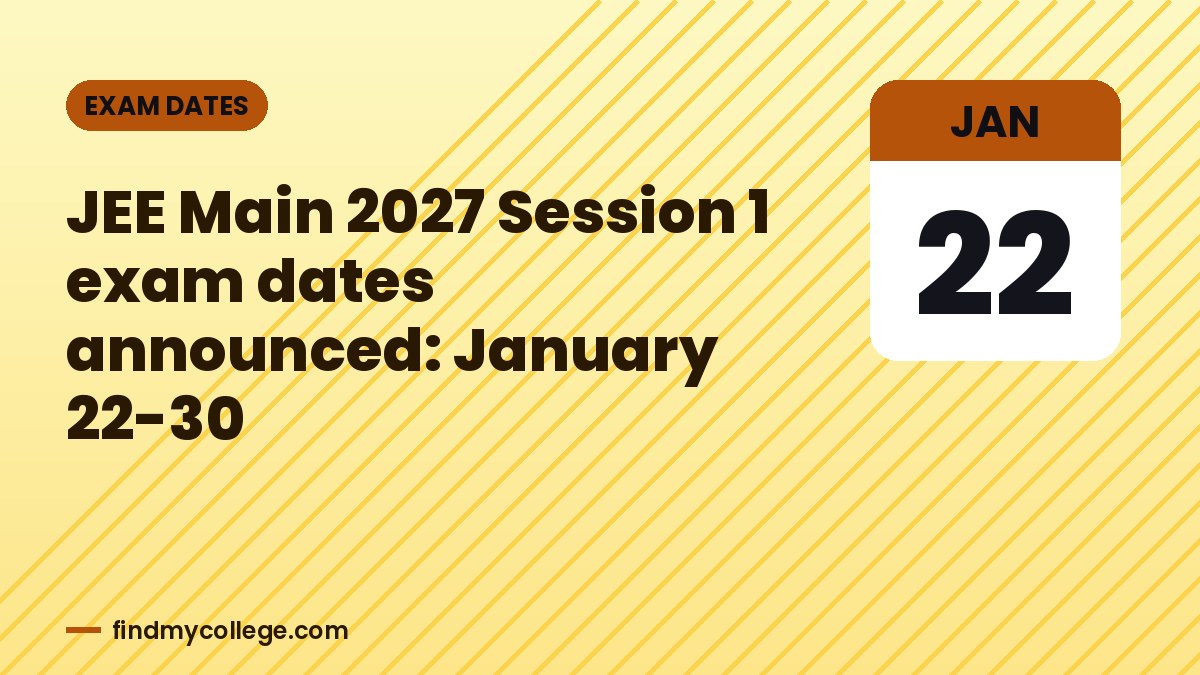
- The JEE Main 2027 Session 1 examination will be conducted on January 22, 23, 24, 28, 29, and 30, 2027.
- A buffer date of January 31, 2027, has been allocated for the Session 1 exam.
- Registration for JEE Main 2027 Session 1 is expected to commence in October 2026 and conclude in November 2026.
- Candidates who passed Class 12 in 2025, 2026, or are appearing in 2027 are eligible to apply for JEE Main 2027.
- The application fee for General Male candidates is Rs 1000.
The National Testing Agency (NTA) officially announced the examination dates for JEE Main 2027 Session 1 on September 16, 2026, as part of its Examination Calendar (December 2026 Cycle onwards). The entrance examination, a national-level test for admission to undergraduate engineering courses across NITs, IIITs, CFTIs, and state-funded or recognised institutions, will take place on January 22, 23, 24, 28, 29, and 30, 2027. January 31, 2027, has also been designated as a buffer date for the Session 1 exam.

JEE Main 2027 will be conducted in two sessions, with Session 1 in January and Session 2 anticipated in April 2027. Candidates have the option to appear in one or both sessions. The NTA’s public notice dated September 16, 2026, indicates that all announced dates are tentative and subject to change due to administrative, academic, statutory, logistical, or other unforeseen circumstances.
Examination Structure and Eligibility Criteria
The JEE Main examination is primarily a Computer-Based Test (CBT), except the Drawing section of Paper 2A (B.Arch). Paper 1 (B.E./B.Tech.) Consists of 75 questions, carrying a maximum of 300 marks. Paper 2A (B.Arch) includes 77 questions for a total of 400 marks, while Paper 2B (B.Plan) has 100 questions, also for 400 marks. The marking scheme awards +4 marks for every correct answer and deducts -1 mark for every wrong answer in Multiple Choice Questions (MCQs).
Eligibility for JEE Main 2027 extends to candidates who passed Class 12 in 2025, 2026, or are appearing for their Class 12 examinations in 2027. There is no specified upper or lower age limit for appearing in the examination. For admission to NITs, IIITs, and CFTIs, candidates from the General category must secure at least 75% marks in Class 12, while SC/ST category candidates require a minimum of 65% marks.
Key Dates and Application Process
The registration process for JEE Main 2027 Session 1 is expected to commence in October 2026 and conclude in November 2026. Candidates are required to complete the registration form through the online mode only via the official JEE Main website. The application fee for General Male candidates is Rs 1000. The NTA has advised candidates to ensure that the email address and mobile number provided in the online application form belong to them or their parents/guardians.
| Particulars | Date |
|---|---|
| Session 1 Exam | January 22, 23, 24, 28, 29 and 30, 2027 |
| Buffer Date | January 31, 2027 |
| Session | January 2027 |
Results for JEE Main 2027 Session 1 are anticipated around February 2027, with Session 2 results expected around April 2027. The NIFT Entrance Examination is scheduled for January 10, 2027, preceding the JEE Main Session 1 dates. The NTA will release a detailed Information Bulletin separately, and candidates are advised to regularly check the official JEE Main website for the latest updates.
Exam Languages and Reservation Policy
The JEE Main examination will be conducted in 13 languages to accommodate a diverse range of candidates across India. These languages include English, Hindi, Assamese, Bengali, Gujarati, Kannada, Malayalam, Marathi, Odia, Punjabi, Tamil, Telugu, and Urdu. This multilingual approach aims to provide accessibility for students from various linguistic backgrounds.
The reservation policy for admissions to NITs, IIITs, and CFTIs includes 10% for Gen-EWS, 27% for OBC-NCL, 15% for SC, 7.5% for ST, and 5% for PwD categories. JEE Main also serves as an eligibility test for JEE (Advanced), which is the entrance examination for admission to the Indian Institutes of Technology (IITs).
Further reading

📰 More Education News
- PSSOU: Register for UG/PG by Oct 13, 2026. Allama Sundar Lal NEP UG: Register by Sep 18Sep 19, 2026 • Nishit Kumar
- Harvard University executive education courses launch in Hyderabad from December 2026Sep 19, 2026 • Nishit Kumar
- MHCET LAW 5 Year LLB 2026 CAP Round 3 seat allotment releasedSep 19, 2026 • Nishit Kumar
- IIM Visakhapatnam EMBA 2026-28: Apply for Winter batch admissions nowSep 19, 2026 • Nishit Kumar