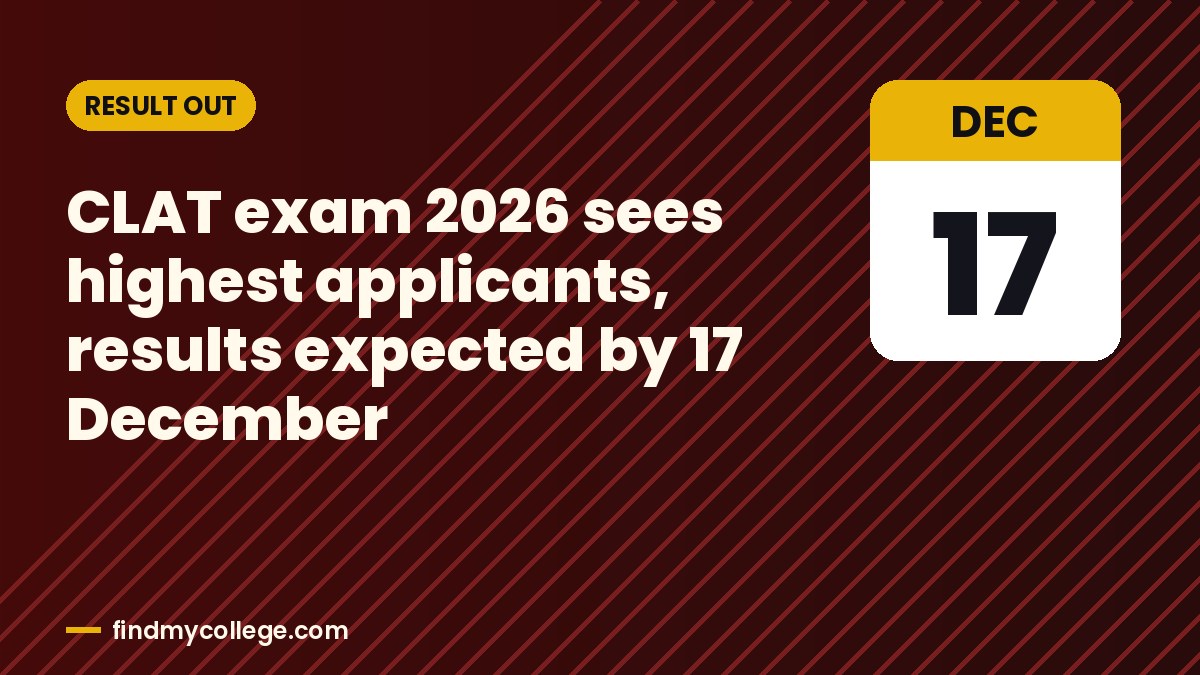
CLAT exam 2026 sees highest applicants, results expected by 17 December
In short
- CLAT 2026 received 92,344 applications, marking the highest number in the exam's history.
- The national-level entrance exam is scheduled for 6 December 2026.
- Results for CLAT 2026 are expected to be declared around 15-17 December 2026.
- The application period for CLAT 2026 ran from August to October 2026.
- CLAT scores are considered by 27 National Law Universities and 42 affiliated universities for law admissions.
The Common Law Admission Test (CLAT) 2026 has registered a record 92,344 applicants, the highest in the exam’s history, according to data from the Consortium of NLUs. This national-level entrance examination, crucial for admission to undergraduate (UG) and postgraduate (PG) law programs across India, is set to be conducted on 6 December 2026.
The CLAT exam serves as a standardized screening test for admissions to 27 National Law Universities (NLUs) and 42 other affiliated universities. The application window for CLAT 2026 was open from August to October 2026, with results expected to be declared between 15 and 17 December 2026, followed by counselling a few weeks later.
Overview of CLAT Exam and Its Scope
CLAT, or the Common Law Entrance Test, is a centralized national-level entrance examination designed to evaluate candidates on reasoning, legal aptitude, general knowledge, English language skills, and quantitative techniques. It is primarily conducted for admission to five-year undergraduate LLB and one-year postgraduate LLM programmes. Beyond NLUs, 60 other top colleges in India also consider CLAT scores for admissions.
The exam also holds significance for postgraduate candidates, as Public Sector Undertakings (PSUs) consider CLAT LLM scores for recruitment. Private colleges that accept CLAT scores often provide various scholarships to rank holders, adding another incentive for aspiring law students to perform well in the examination.
Eligibility and Exam Structure
For undergraduate law courses, candidates must have passed 10+2 or an equivalent examination with a minimum score of 45% (40% for SC/ST categories). There is no upper age limit to appear for the CLAT exam, and candidates must be Indian citizens or NRIs. For postgraduate programs, candidates with completed 3-year or 5-year LLB courses are eligible, requiring a minimum of 50% marks for General/OBC/PWD/NRI categories and 45% for SC/ST categories.
The CLAT UG exam syllabus includes English Language, Current Affairs, Logical Reasoning, Quantitative Techniques, and Legal Reasoning. It is a two-hour examination with 120 questions, each carrying one mark, and a negative marking of 0.25 marks for each incorrect answer. The CLAT PG exam also has a two-hour duration with 120 questions, each worth one mark, and a 0.25 mark deduction for wrong answers. Its syllabus covers subjects such as Criminal Law, Property Law, Tax Law, Environmental Law, Constitutional Law, Company Law, Administrative Law, Family Law, Jurisprudence, and Law of Contract.
Historical Context and Applicant Trends
Before the introduction of CLAT in 2008, each NLU conducted its own entrance examination, creating a challenging preparation landscape for students. A court case in 2006 led to the decision for a common law entrance exam, with the National Law School of India University (NLSIU) in Bangalore introducing CLAT. Initially, a committee from seven NLUs managed its operation, with a different NLU organizing the exam each year. In 2019, the Consortium of NLUs was formed to assume responsibility for organizing CLAT exams, standardizing the admission process across India and ensuring merit-based admissions. NLU Delhi continues to use its own entrance exam, AILET, for admissions.
The consistent increase in applicant numbers underscores the growing interest in law as a career path and the importance of CLAT as the primary gateway. The CLAT registration fee is INR 4,000 for General/OBC/PWD/NRI/PIO/OCI candidates and INR 3,500 for SC/ST/BPL candidates. Admit cards are typically released two to three weeks before the exam date. Around 75,000 students appear for the CLAT UG exam annually, and approximately 15,000 for the CLAT PG exam each year.
| Exam Year | No. of Applicants (UG & PG) |
|---|---|
| CLAT 2020 | 75183 |
| CLAT 2021 | 70277 |
| CLAT 2022 | 60895 |
| CLAT 2023 | 62000+ |
| CLAT 2024 | 71243 |
| CLAT 2025 | 78915 |
| CLAT 2026 | 92344 |
Further reading

📰 More Education News
- CLAT 2027: Register and pay fee by October 31. Registration opens August 3Sep 21, 2026 • Nishit Kumar
- MCA admission 2026: Bhubaneswar colleges offer AI, Cloud specialisations; OJEE counselling seats filling fastSep 21, 2026 • Nishit Kumar
- MAT December 2026 exam dates not announced yet, check AIMA official portalSep 21, 2026 • Nishit Kumar
- CBSE Class 10 and 12 Board Exams 2027 LOC process begins: check fees and datesSep 21, 2026 • Nishit Kumar